Special report for U.S. investors, October 2026
Washington Put 50% Tariffs On Canadian Steel, Aluminum & Copper, Not On Nickel Or Cobalt. The Stock Behind A Rare Magnetic Nickel-Cobalt Alloy Discovery Is Beating Nickel & The Nickel Miners ETF In 2026.
First Atlantic Nickel & Cobalt Corp. (OTCQB: FANCF, TSX-V: FAN) owns 100% of Pipestone XL, a 30 km belt in central Newfoundland where awaruite, a natural nickel-iron-cobalt alloy, is concentrated with magnets instead of a smelter. So far in 2026 the company has verified the mineralogy, with awaruite grading up to 77.62% nickel in the alloy, and has produced a 67.4% nickel alloy concentrate with 1.76% cobalt using only magnetic separation and flotation, no smelting required. It has also discovered two new large-scale areas, Alloy Max North and Alloy Max South, in addition to the RPM Zone discovery drilled in 2024 and 2025.
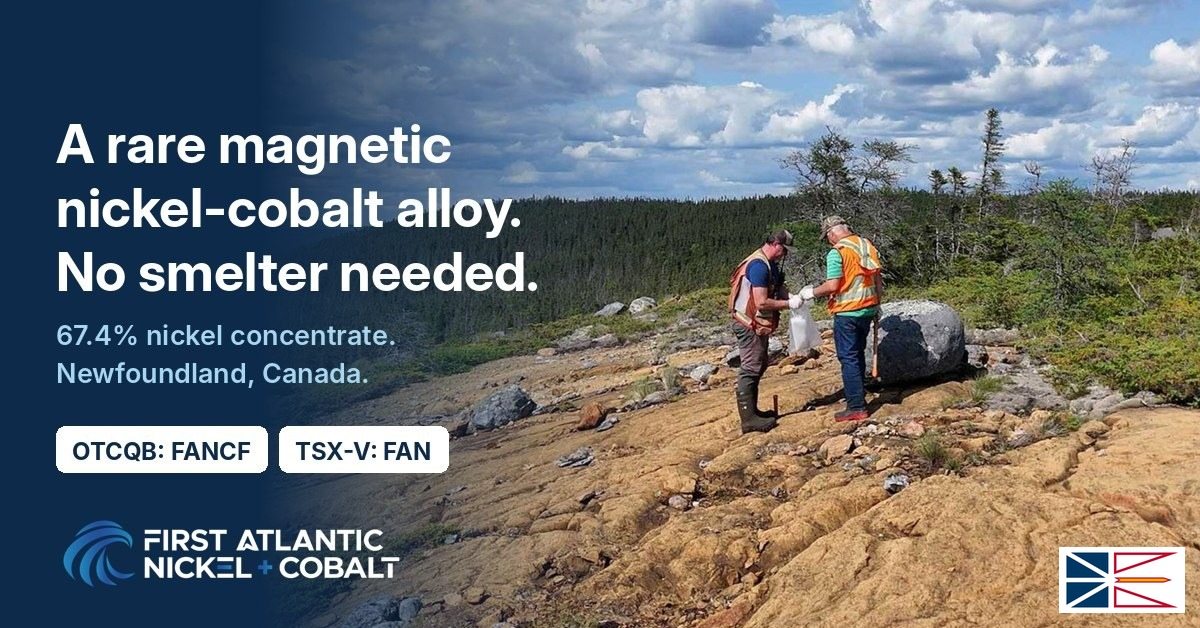
Why Investors Are Watching FANCF: A Rare, Large-Scale Magnetic Nickel-Cobalt Alloy Discovery That Bypasses the Smelting Bottleneck and Could Onshore North American Critical Mineral Supply
First Atlantic Nickel & Cobalt owns 100% of the Pipestone XL Nickel-Cobalt Alloy Project, a 30 km belt in central Newfoundland, Canada. Its target is awaruite (Ni3Fe), a rare, naturally magnetic nickel-iron-cobalt alloy that can be pulled from crushed rock with magnets and upgraded by flotation, with no smelter.[1]
The G7 has already singled nickel out. In June 2026 the G7 leaders named nickel, with lithium, one of the first two pilot minerals for a new allied critical minerals traceability framework.[2]
Washington named the problem itself. On January 14, 2026 the White House, in Proclamation 11001, found that the United States mines cobalt and nickel but cannot process them:[3]

“Even where the United States has domestic mining capacity, such as for cobalt, nickel, and rare earth elements, the United States lacks the domestic processing capacity to avoid downstream net-import reliance.”[3]
Mining more nickel in Canada or the United States does not fix the problem. Nickel mined in North America today is sulfide ore, which needs a smelter to reduce the nickel to metal before a refinery can process it. The United States has no nickel smelter: its last one, in Oregon, closed in 1998,[4] and its last nickel refinery, in Louisiana, closed in 1985.[5] One of Canada’s smelters closed in 2018, leaving two aging smelters still running.[6] Rising electricity demand and prices, tougher environmental regulations and billions of dollars of capital on top of the cost of a mine[7] put the economics of new smelting in North America in question. So what could the United States do to secure the nickel its defense, aerospace, stainless steel and battery manufacturers depend on?
First Atlantic Nickel & Cobalt (OTCQB: FANCF, TSX-V: FAN) offers a large-scale, environmentally sustainable solution on North American soil. Its Pipestone XL discovery is awaruite (Ni3Fe), a rare magnetic nickel-iron-cobalt alloy that nature has already reduced to metal. It can be processed without smelting, bypassing the midstream bottleneck: the alloy concentrate could go directly to downstream refining on U.S. soil for nickel metal or nickel sulfate for batteries, a vertically integrated supply chain from a large-scale North American mine to a U.S. refinery with no smelter in between. Pipestone XL could potentially supply a large volume of secure nickel and cobalt to U.S. or allied North American refineries, with no reliance on offshore smelting controlled by China, Russia and Chinese-owned plants in Indonesia: a national economic security asset as much as a mining one.
Investing early means knowing first. Free investor updates on FANCF: drill results, lab results and news by email and text as they are released.
Investor Updates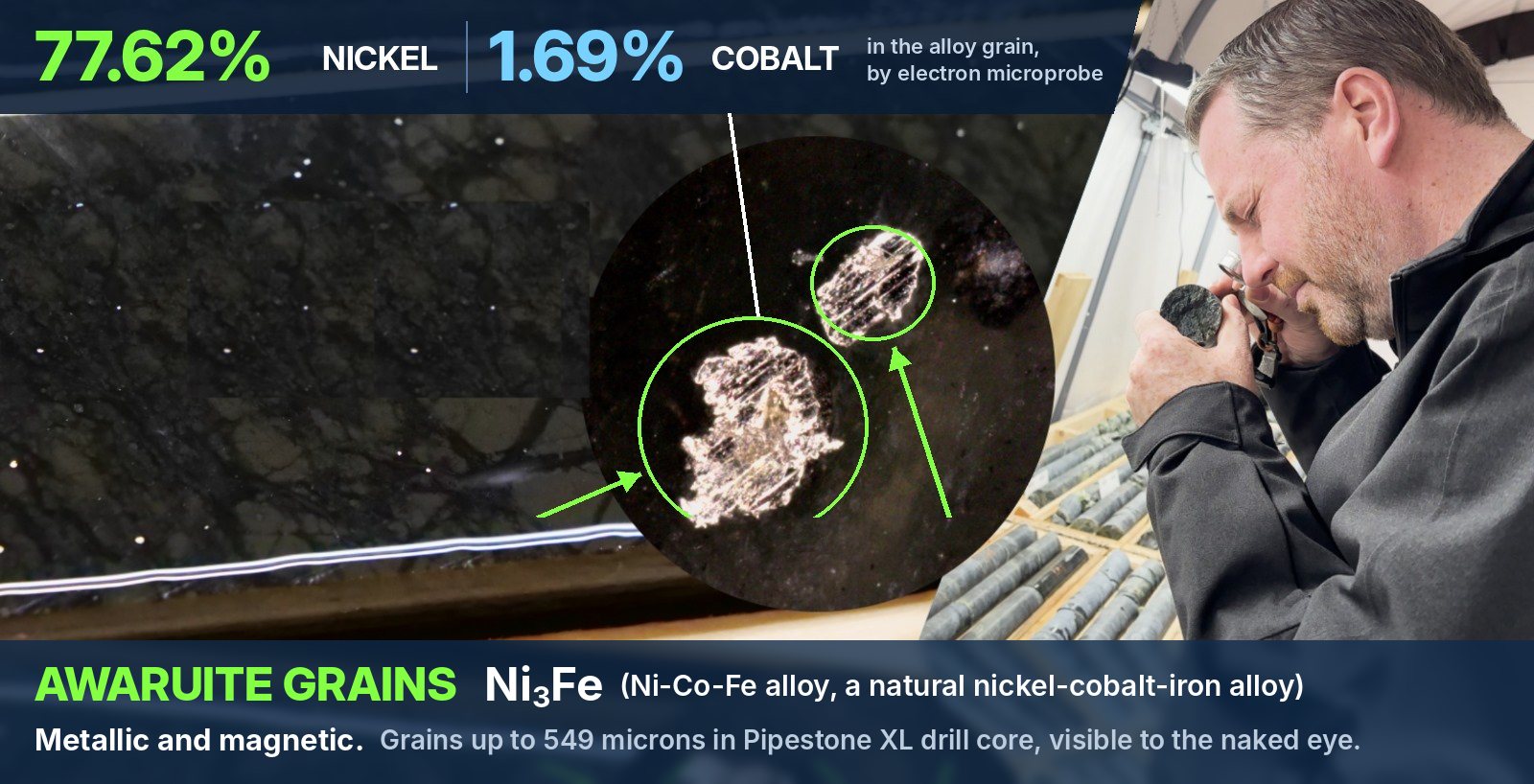
Key Investor Highlights
- Proven Mineralogy, 77.62% Nickel in the Alloy: electron microprobe analysis by SGS Canada of RPM Zone awaruite returned 77.62% nickel and 1.69% cobalt in the alloy grains, up to 86.68% nickel and 6.05% cobalt.[8]
- Proven Metallurgy, a Pure Alloy Concentrate: magnetic separation and flotation at SGS upgraded RPM Zone rock into a nickel-cobalt alloy concentrate averaging 67.4% nickel, up to 71.9% nickel, with 1.76% cobalt, with no smelter.[9]
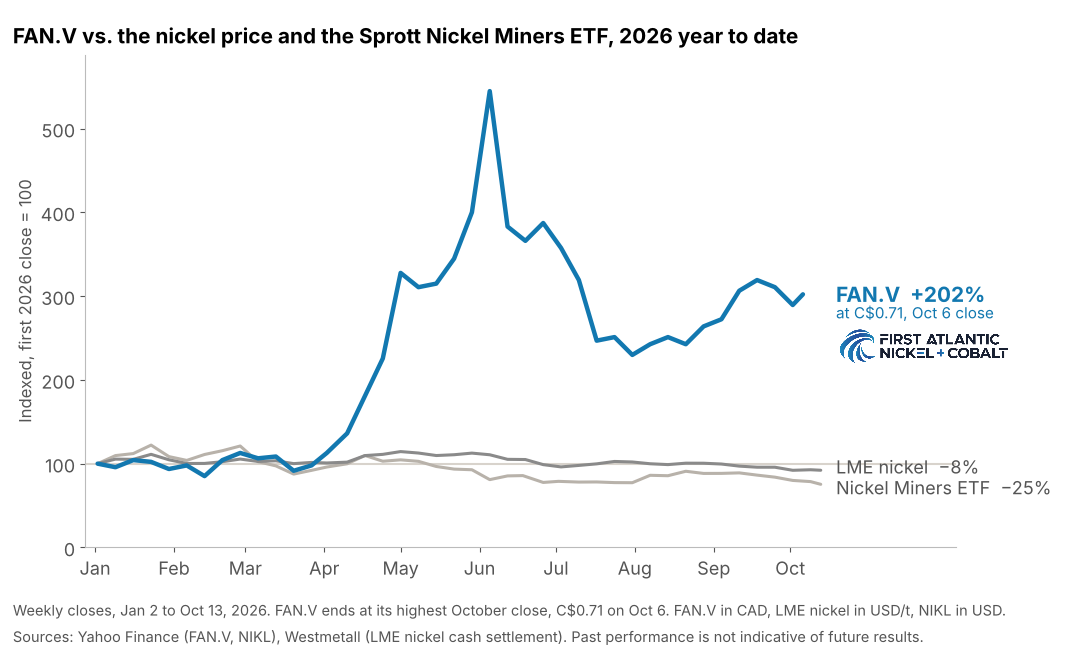
- Outperforming Nickel and the Nickel Miners in 2026: while the nickel price and the Sprott Nickel Miners ETF both fell, First Atlantic shares rose, up 202% at their highest October close. Past performance is not indicative of future results.[10][11][12]
- 30 km District-Scale Ophiolite: a continuous belt of nickel-bearing ultramafic rock, mapped at hundreds of meters to over 1 km wide and about 30 km long, enriched in nickel, cobalt and chromium and 100% owned by First Atlantic.[13]
- Already 5 Zones Across 30 km, Multi-Pit Potential: three new discoveries, RPM, Alloy Max North and Alloy Max South, plus the historic Atlantic Lake and Super Gulp zones. Alloy Max alone now spans about 2.4 km of strike after the first Alloy Max South hole hit awaruite within 35 meters of surface on October 13.[14]
- Fully Funded for 2026 and 2027: the drill program is funded through 2027 after about $13.4 million was raised since September 2026 in three no-warrant private placements, the latest at a 22% premium to market.[1]
- DIBC Member (Defense Industrial Base Consortium): First Atlantic was accepted as a member on March 31, 2026, and has submitted a proposal under RPP-CM-26-01, Domestic Processing Capabilities of Critical Minerals, the consortium’s Request for Project Proposals that names nickel.[15]
- No Tariffs on Nickel or Cobalt: Washington put 50% Section 232 tariffs on Canadian steel, aluminum and copper, but put no tariff on nickel or cobalt. The proclamation says the United States lacks the ability to process them.[16][17][18]
In the United States the company trades as OTCQB: FANCF. Look up FANCF at your broker, add it to your watchlist and sign up below for free email and text alerts as drill and lab results are released.


Gracelin Baskaran, Director, Critical Minerals Security Program, CSIS

“Given the United States does not have a single completed nickel refinery, Canada is an important ally.”[19]
Why the United States Has Not Fixed Its Nickel Problem, and Why Imports Alone Will Not Solve It
The United States mines about 10,000 tonnes of nickel a year, and without scrap its import reliance would be nearly 100%.[5] The nickel in its ground is sulfide or laterite, and both need a smelter or a high-pressure acid leach plant before a refinery can process them. The United States has neither, so even the reserves it holds have had nowhere to go at home.
Nobody is building one. A new smelter can cost billions of dollars on top of the cost of building a mine, in some cases double or triple the cost of the mine itself. A nickel smelter or acid leach plant also means years of environmental permitting, heavy water use, sulfur and acid waste, and enormous amounts of electricity, which now competes with AI data centers for the same power at rising prices. The one large smelter Washington is backing, Project Crucible, is a roughly $7 billion project, and it is not for nickel.[7] Imports alone will not solve it: nickel concentrate bought from another country still has to be smelted or leached before it can be refined, so it would arrive with nowhere to go, and Canada’s two remaining smelters are running near capacity under tougher environmental rules. Beyond North America the midstream sits in China, Russia and Chinese-owned plants in Indonesia.
Washington has already drawn the policy line. Steel, aluminum and copper have carried a 50% Section 232 tariff since 2025,[16][17] kept at 50% in the April 2026 restructuring.[20] Nickel and cobalt were not tariffed: Proclamation 11001 named them as minerals the United States mines but cannot process, and imposed no tariff.[18] First Atlantic was accepted into the Defense Industrial Base Consortium on March 31, 2026 and has submitted a proposal under its critical minerals processing request, a route to funding, not an award.[15] Tariff-free, defense-listed and G7-tracked: that is the policy frame around a nickel-cobalt alloy that needs no smelter.
Awaruite, the Rare Form of Nickel: A Naturally Magnetic Nickel-Iron-Cobalt Alloy Concentrated and Separated Without Smelting
Almost all of the world’s nickel is mined as sulfide or laterite ore. Sulfide nickel is chemically bound to sulfur, which a smelter burns off at high temperature, releasing SO2. Laterite nickel is spread through clay-rich soil and dissolved out with acid under high pressure. Both routes need costly plants and large amounts of power, and both are hard to permit in North America.
Awaruite is a rare third form: nickel that nature has already turned into metal. Awaruite (Ni3Fe) is a nickel-iron-cobalt alloy (Ni-Fe-Co), formed when ancient ocean mantle rock was altered by water through serpentinization. It is naturally magnetic, so it can be concentrated with magnetic separator drums, the technology proven on Minnesota’s Mesabi Iron Range and in Labrador’s iron mines for more than a century.
“The development of awaruite deposits in other parts of Canada may help alleviate any prolonged shortage of nickel concentrate. Awaruite, a natural iron-nickel alloy, is much easier to concentrate than pentlandite, the principal sulfide of nickel.”[21]
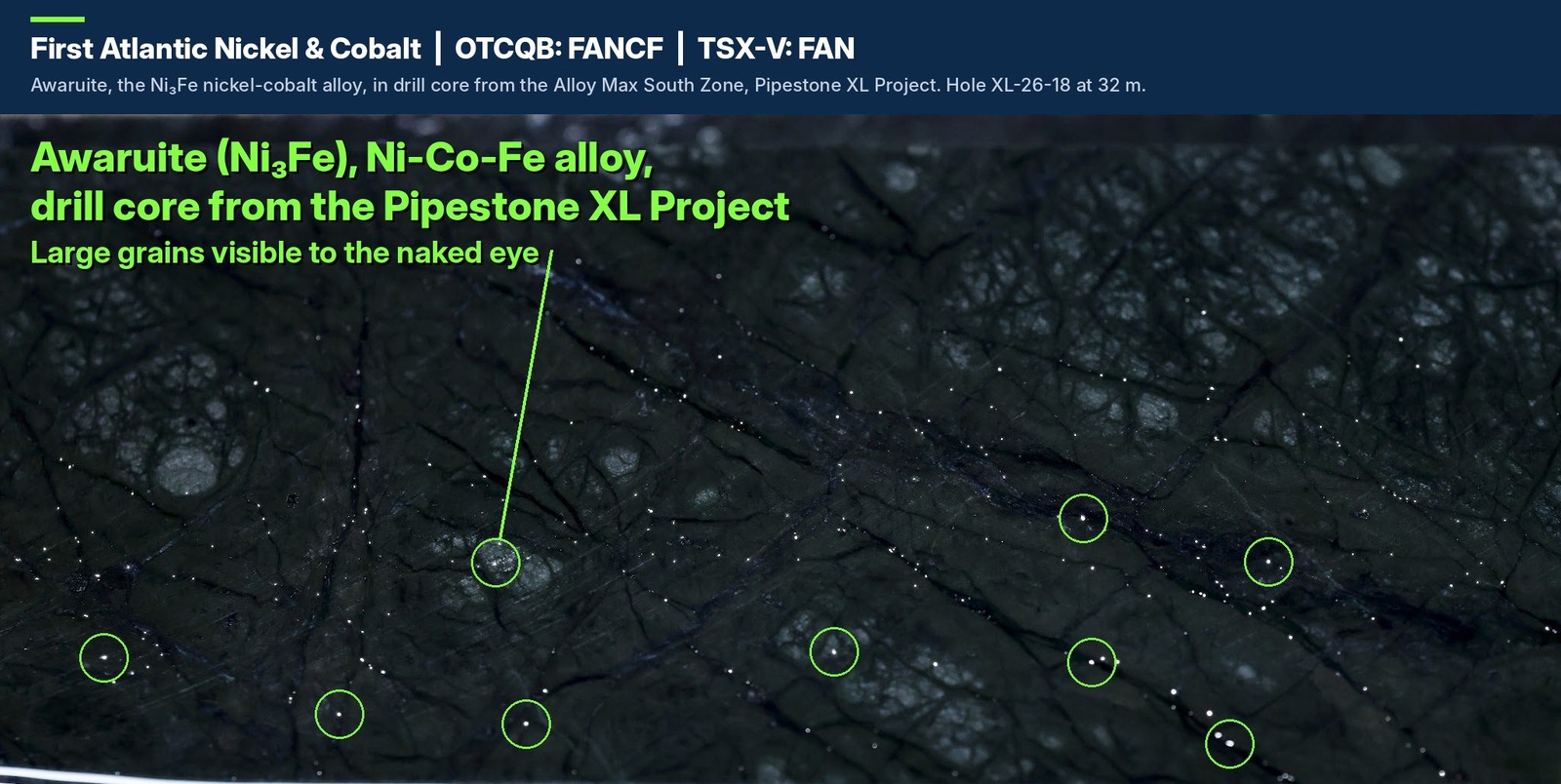
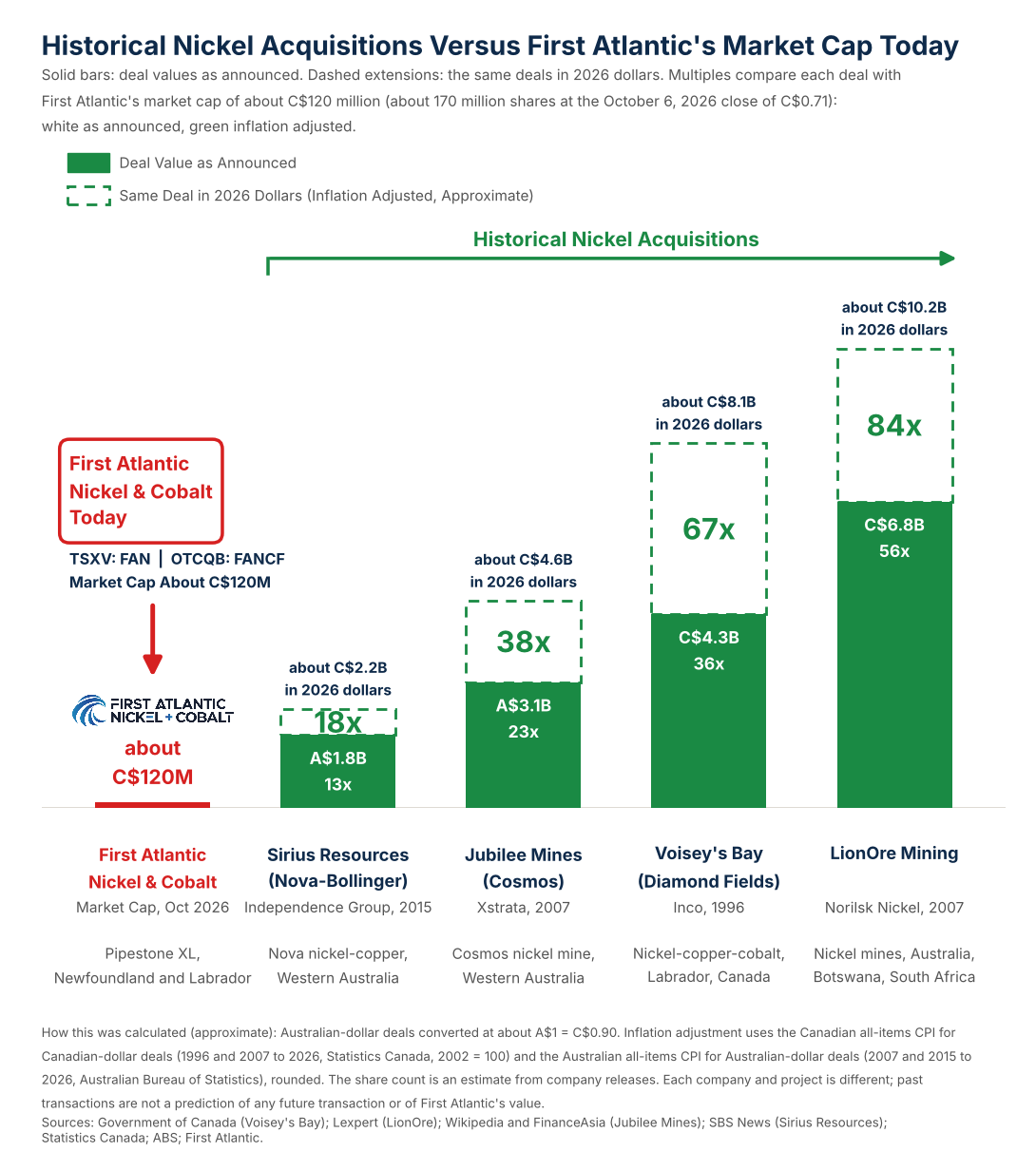
First Atlantic has drilled the first major awaruite discovery since the USGS wrote that in 2012.[21] Pipestone XL is the largest nickel-cobalt alloy and chromium discovery in the Atlantic in 30 years, since Voisey’s Bay, acquired for $4.3 billion in 1996, more than $8 billion in today’s dollars.[22]
The grains themselves have been measured. In May, electron microprobe analysis of RPM Zone core returned an average of 77.62% nickel and 1.69% cobalt in the awaruite, with peaks of 86.68% nickel and 6.05% cobalt.[8] Cobalt travels inside the alloy, which is why the company became First Atlantic Nickel & Cobalt on April 29, 2026.[23]
Smelting is the choke point of the North American nickel supply chain, and the step awaruite avoids. With the last U.S. nickel smelter closed since 1998[4] and only two left in Canada,[1][24][6] no new nickel smelters are being built or funded on the continent, and none is planned that would meet future demand.
Now the U.S. Department of War. Defense Production Act Title III nickel announcement

“Nickel is an essential mineral input to produce high-temperature aerospace alloys, stainless steel, and chemicals for lithium-ion batteries.”[25]
The one new smelter the U.S. Department of War is backing is not for nickel or cobalt. Project Crucible, Korea Zinc’s roughly $7 billion plant at Clarksville, Tennessee, is for zinc, lead, copper and other metals, and faces years of permitting, new power supply and grid upgrades before first metal around 2029.[7][26][27]
First Atlantic has a way around that bottleneck, not a plan to build through it: Pipestone XL rock can be concentrated at the mine with magnets and flotation and shipped straight to a North American refinery, with no smelter, no multi-billion-dollar plant and no new power build-out,[9] cutting the dependence on processing in China, Russia and Chinese-controlled plants in Indonesia and putting a nickel and cobalt source for U.S. industry on the allied side of the border.
Click the map for a larger, high-resolution view
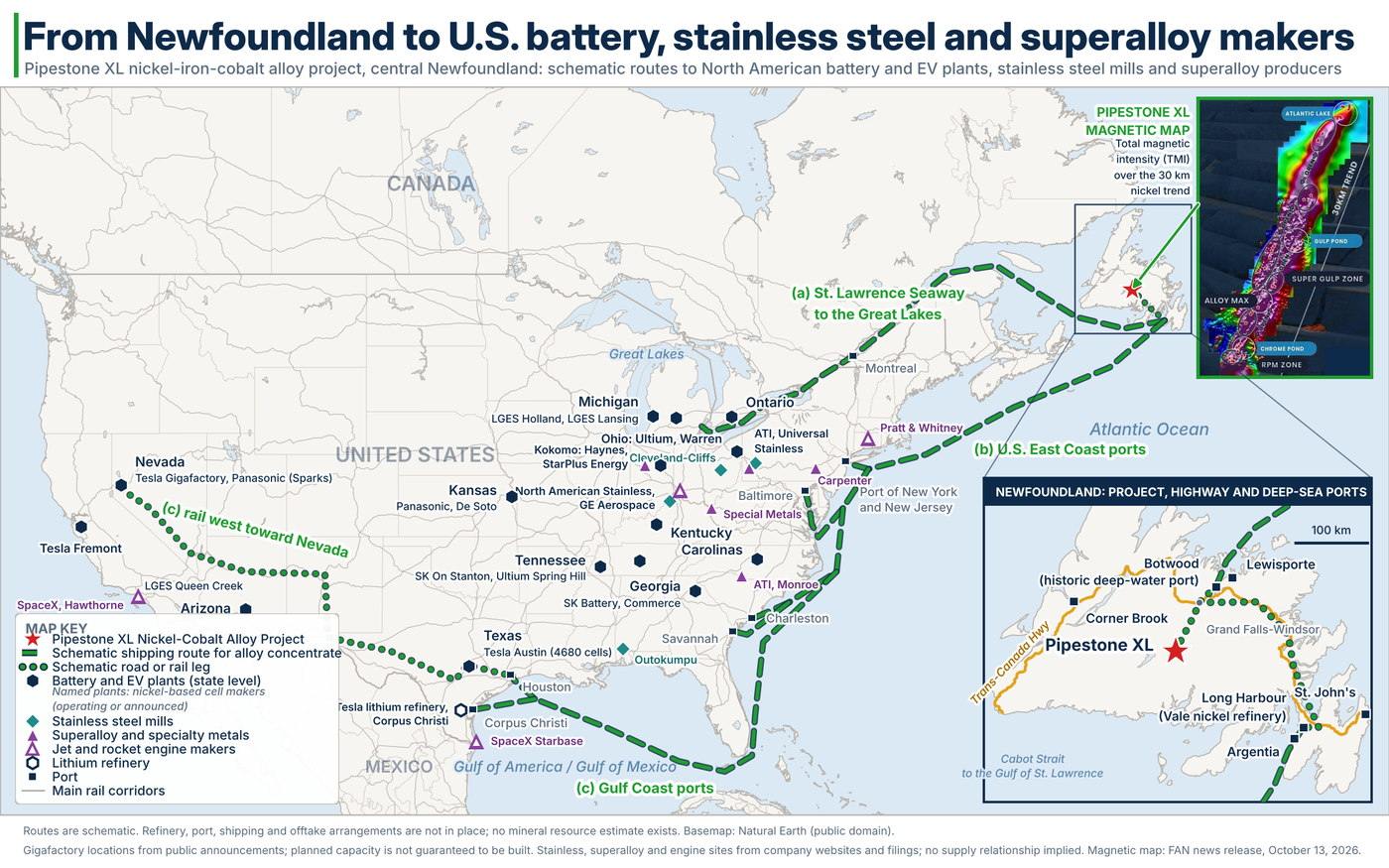
No smelting saves billions in capital and cuts electricity demand. Against sulfide and laterite nickel, that means:
- Sulfur-free: the rock and its tailings are inert, with no risk of acid mine drainage.
- Lower electricity demand: magnets and flotation cells in place of a high-temperature smelter or an acid-leach autoclave.
- Easier, faster permitting: a safer process with a lower environmental footprint.
Washington is now writing the difference between ore and metal into law. The DOMINANCE Act, passed by the U.S. House in June 2026, defines a processed critical mineral as ore converted “into a metal, metal powder, or a master alloy.”[28] Awaruite is a naturally occurring metal alloy of nickel, iron and cobalt: nature has already completed the conversion the bill defines as the end point of processing.[29]
Senior Strategic Advisor, First Atlantic Nickel & Cobalt
Former Director, Office of Critical Minerals and Metals,
U.S. Department of Commerce

“The Company stands out in the global critical minerals sector with its large-scale discovery of awaruite (Ni3Fe) at its Pipestone XL Project in Newfoundland, an exceptionally rare, naturally-occurring, magnetic, sulfur-free nickel-cobalt-iron alloy. This unique nickel-cobalt mineral can be processed onshore, directly at the mine site, using simple magnetic separation and flotation. The result is a high-grade, environmentally responsible nickel-cobalt concentrate that can move directly into downstream stainless steel, specialty alloy, and battery refining and manufacturing industries supplying the electric vehicle, energy storage, and defense sectors in the United States, Canada, the G7, and allied countries. This is significant because the global critical minerals sector is dominated by a single country that is a non-market economy, and processing awaruite onshore bypasses the midstream smelting and processing constraints concentrated in that country.”[30]
“Because awaruite occurs naturally as a metallic alloy, it can move directly from mine to metal, feeding stainless steel production or refining for downstream applications,” said Dr. Douglas Wicks, Strategic Advisor and former ARPA-E Program Director.[31]
That rare alloy, in that rare form, is what First Atlantic owns across a 30 km belt in Newfoundland.
Click the map for a larger, high-resolution view
ONSHORE MAX™: Magnetic Separation and Flotation Turn Pipestone XL Awaruite Into a 67.4% Nickel Alloy Concentrate
On June 24, First Atlantic released its first metallurgical test work on awaruite, run at SGS Canada under a process it calls ONSHORE MAX™ (Magnetic Alloy eXtraction). The feed was RPM Zone core from the discovery hole, grading about 0.12% magnetically recoverable nickel.[9]
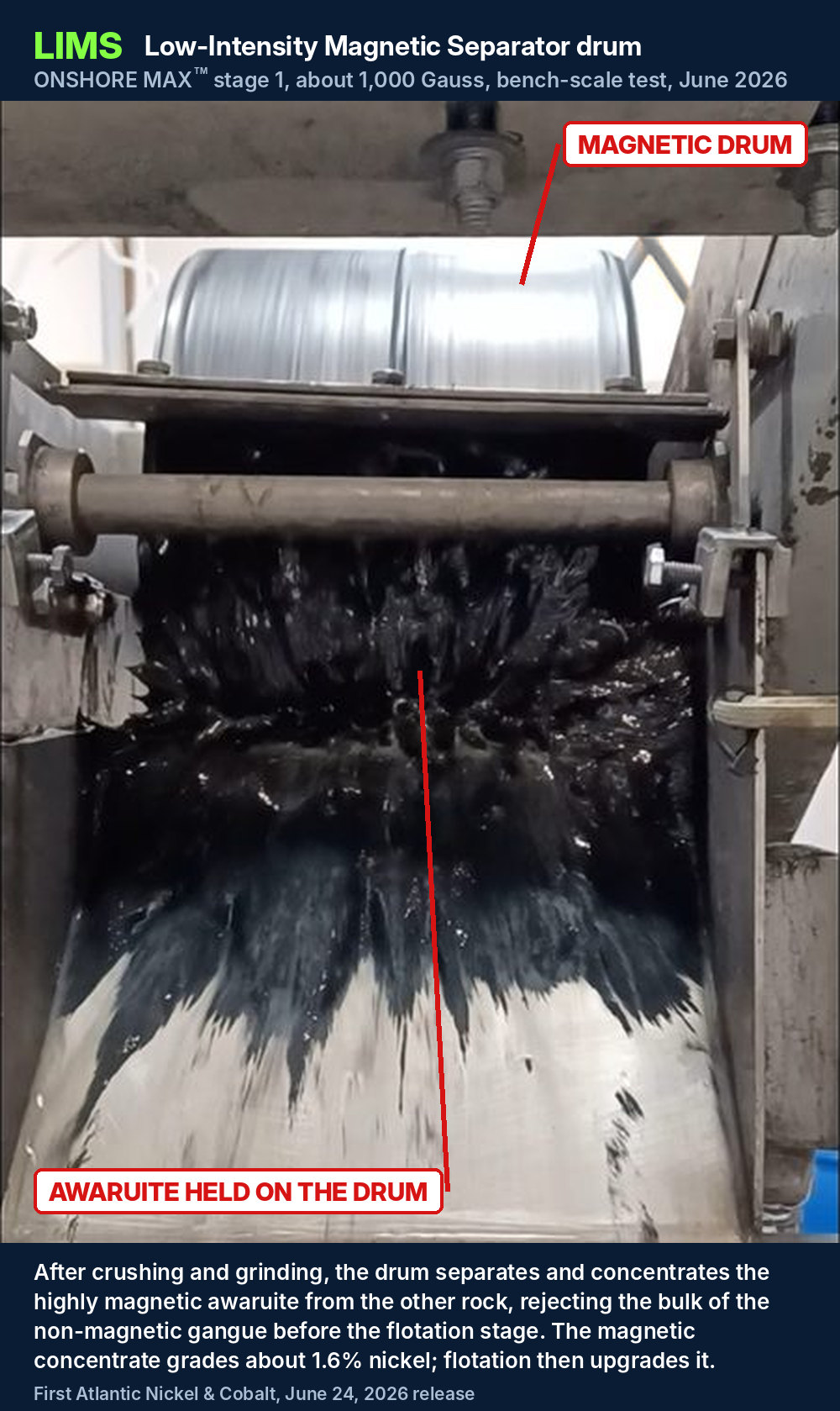
Magnetic Separator Drum.
Crushed rock passes a low-intensity magnetic separator drum at about 1,000 Gauss. The magnet pulls out the awaruite, giving a magnetic concentrate of about 1.6% nickel.[9]
Flotation.
Flotation with a xanthate-based collector then upgrades that magnetic concentrate.
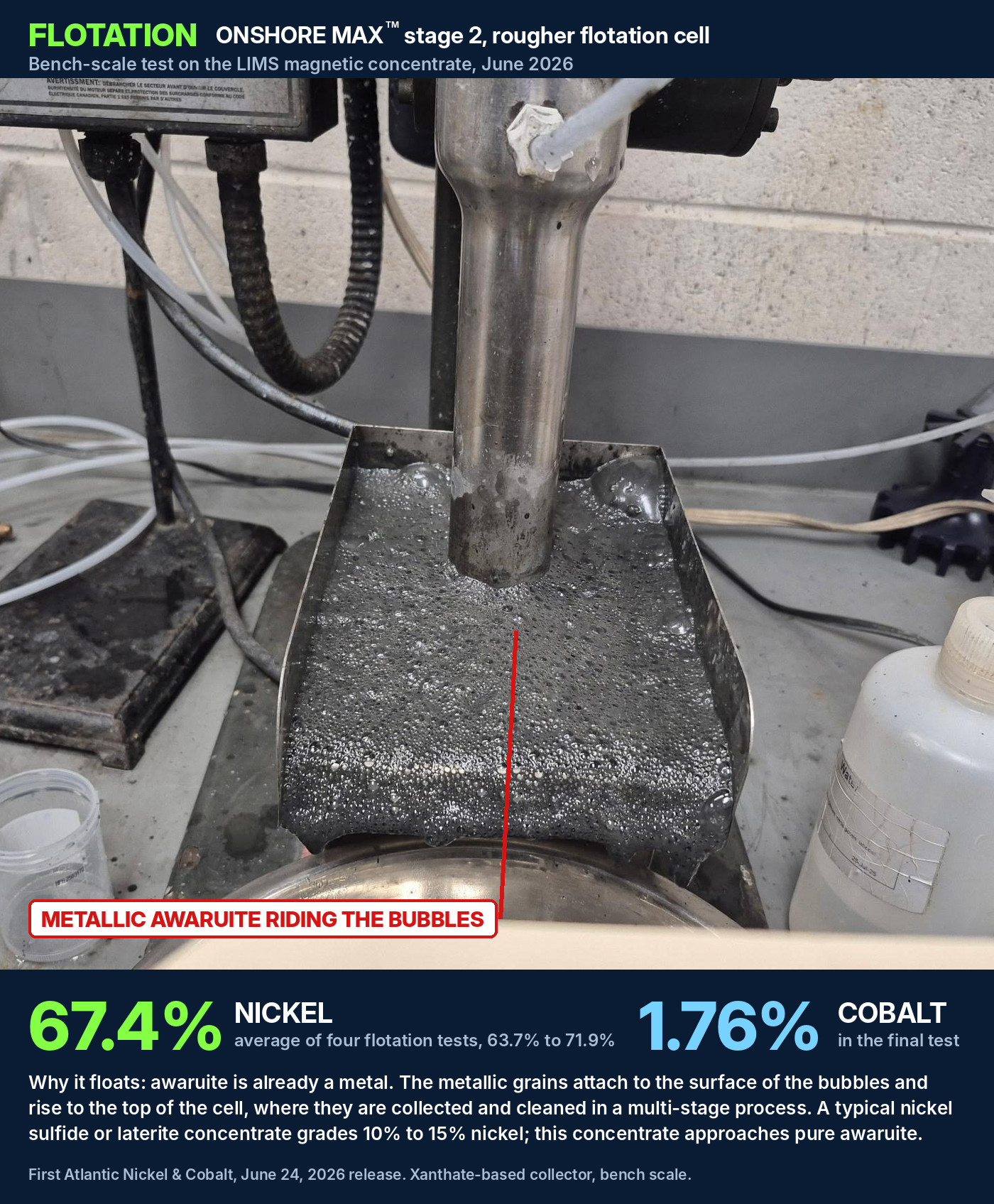
Alloy concentrate.
Four flotation tests averaged 67.4% nickel, from 63.7% to 71.9% nickel, with 1.76% cobalt assayed in the final test.[9]
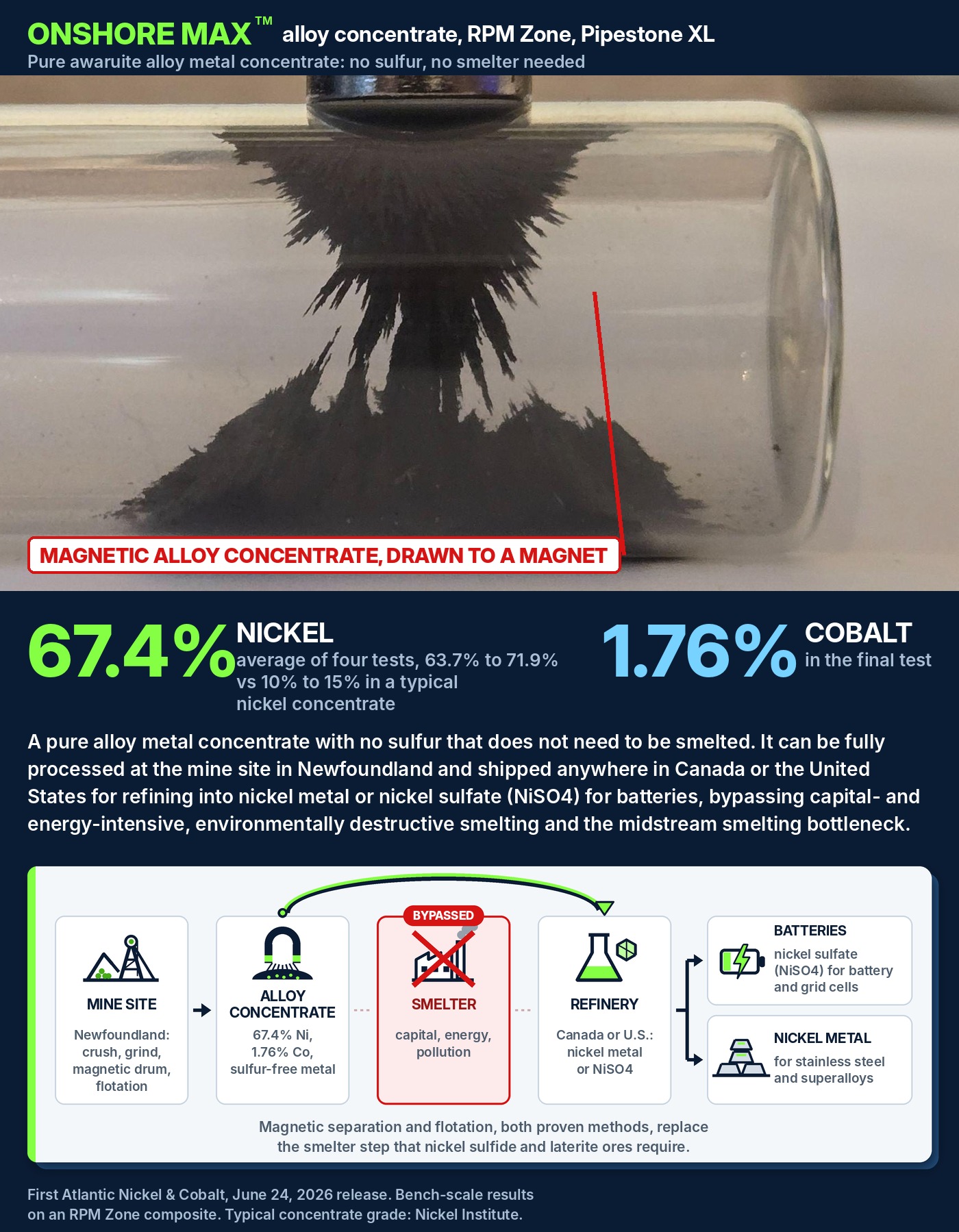
Nickel sulfide concentrates typically run 10% to 15% nickel before smelting, according to the Nickel Institute,[9] more than four times lower than awaruite’s 67.4% concentrate, so every ton shipped and processed carries far less metal.
| Awaruite at Pipestone XL | Sulfide and laterite nickel | |
|---|---|---|
Nickel grade | ✓About 77% nickel, a natural metal alloy | ✕About 25% nickel in sulfide; 1% to 2% in laterite |
Concentrate grade | ✓67.4% nickel average, 63.7% to 71.9%, with 1.76% cobalt | ✕Commonly 10% to 15% nickel, as low as 1% |
Mine-site processing | ✓Magnetic separation and flotation | ✕Flotation, smelting, roasting or high-pressure acid leaching |
Secondary processing | ✓Not required, concentrate ships direct to a refinery | ✕Required: potentially billions in capex for a smelter or HPAL (high-pressure acid leach) plant, plus the energy to run it |
Smelter charges (TC/RC) | ✓None, it does not need to be smelted at all | ✕Charged per tonne of concentrate and deducted from the miner’s payment, plus shipping, and when the smelter is in another country, potential export and import taxes and tariffs on top |
Electricity demand | ✓Low | ✕Higher |
Pollution from acid-generating mine waste | ✓None | ✕SO2, acid mine drainage, sulfuric acid waste |
Tailings | ✓Sulfur-free and inert | ✕Toxic and acid-generating |
Permitting | ✓Faster | ✕Harder: acid mine drainage and water issues |
The difference is in the mineral. Sulfide and laterite nickel have to be broken out of sulfur, oxide or silicate bonds in a smelter or an acid autoclave before they are metal. Awaruite is already a nickel-cobalt-iron alloy, so Pipestone XL rock goes from magnet and flotation cell straight to a high-grade concentrate, and the smelter, its charges, its electricity and its acid waste drop out of the chain.[8] That is ONSHORE MAX™, First Atlantic’s smelter-free process.
Pipestone XL Geology and Drilling: The RPM Zone, Then the Alloy Max North and Alloy Max South Awaruite Discoveries in 2026
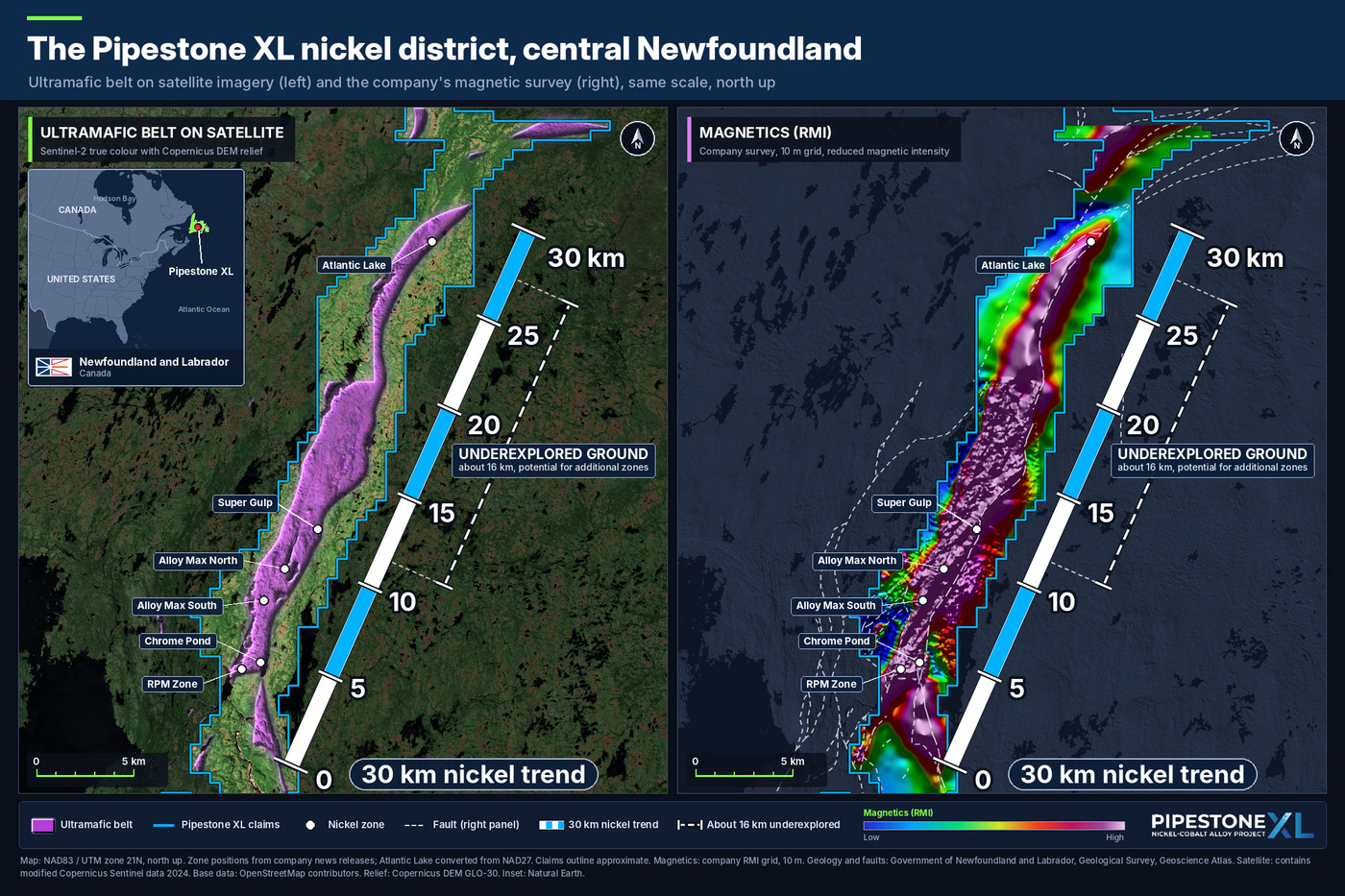
The Pipestone XL Nickel-Cobalt Alloy Project covers the 30 km Pipestone Ophiolite Complex, a 489-million-year-old slab of ancient ocean crust and mantle thrust onto land along the Appalachian Orogen. The whole belt is enriched in nickel, cobalt and chromium through serpentinization, the natural process that frees nickel from the rock and forms the alloy.
Click the map for a larger, high-resolution view
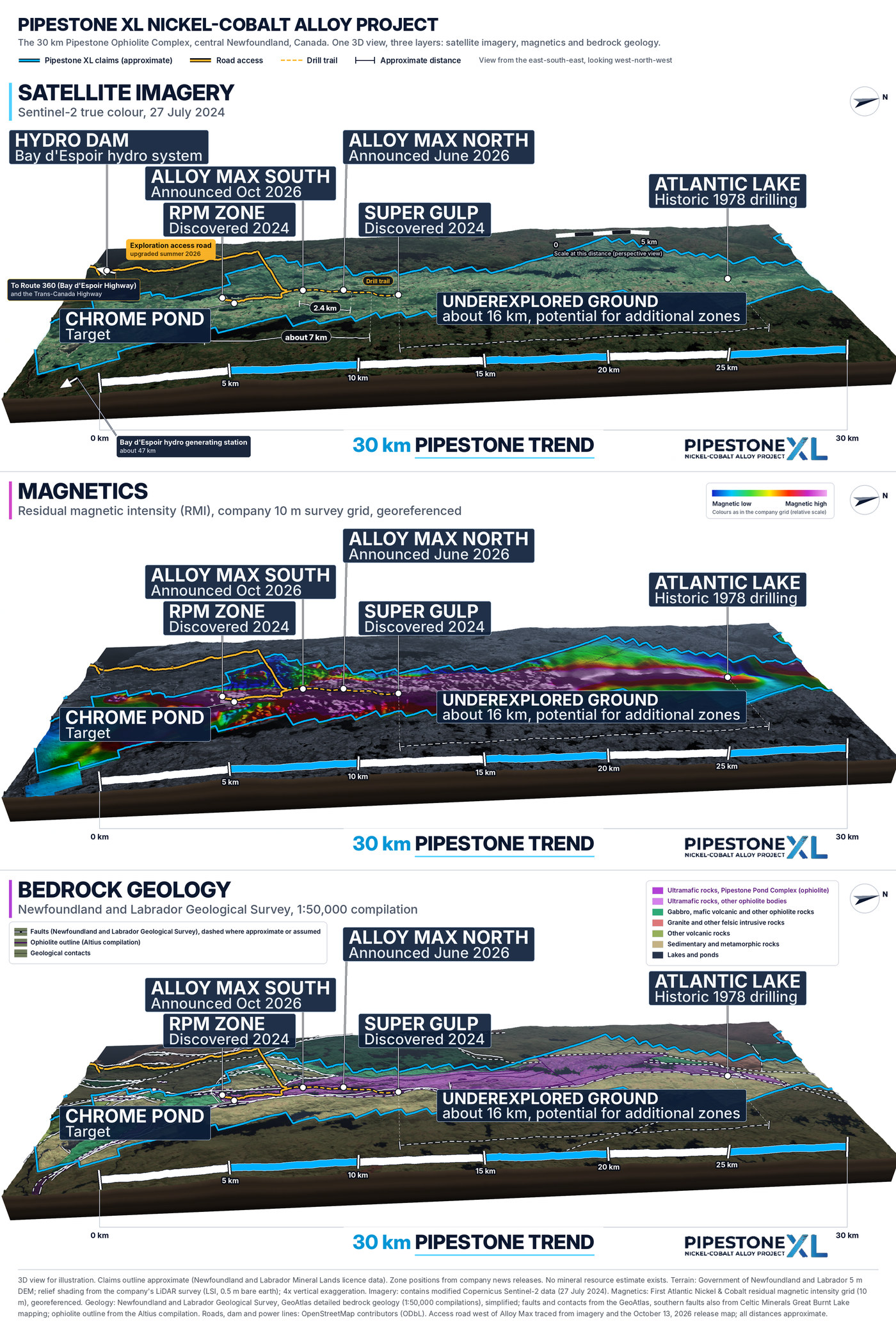
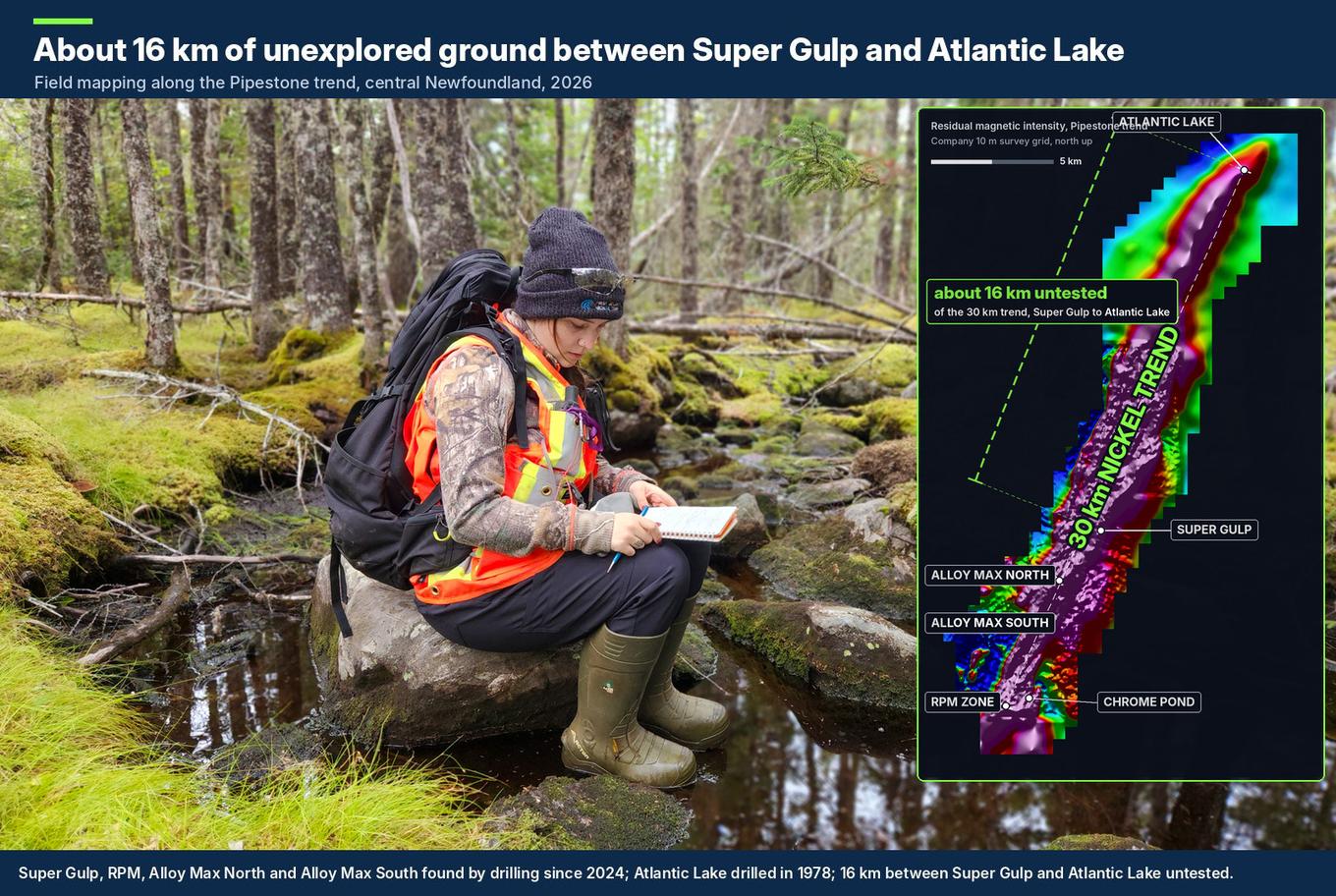
Five zones along the 30 km belt: the historic Atlantic Lake Zone and four found by First Atlantic since 2024, RPM, Super Gulp, Alloy Max North and Alloy Max South, where drilling has confirmed magnetically recoverable awaruite with chromite. About 16 km of the belt, roughly half, is still underexplored, and each new stretch opened along the trend adds potential.
Every drill hole has hit. 18 holes since 2024, every one intersecting awaruite nickel-cobalt alloy with chromite: the first, AN-24-01 at Super Gulp, carried visible awaruite from surface over its full 297 metres, then 13 at RPM and 4 at Alloy Max, four zones found by the drill.[32][13][14]
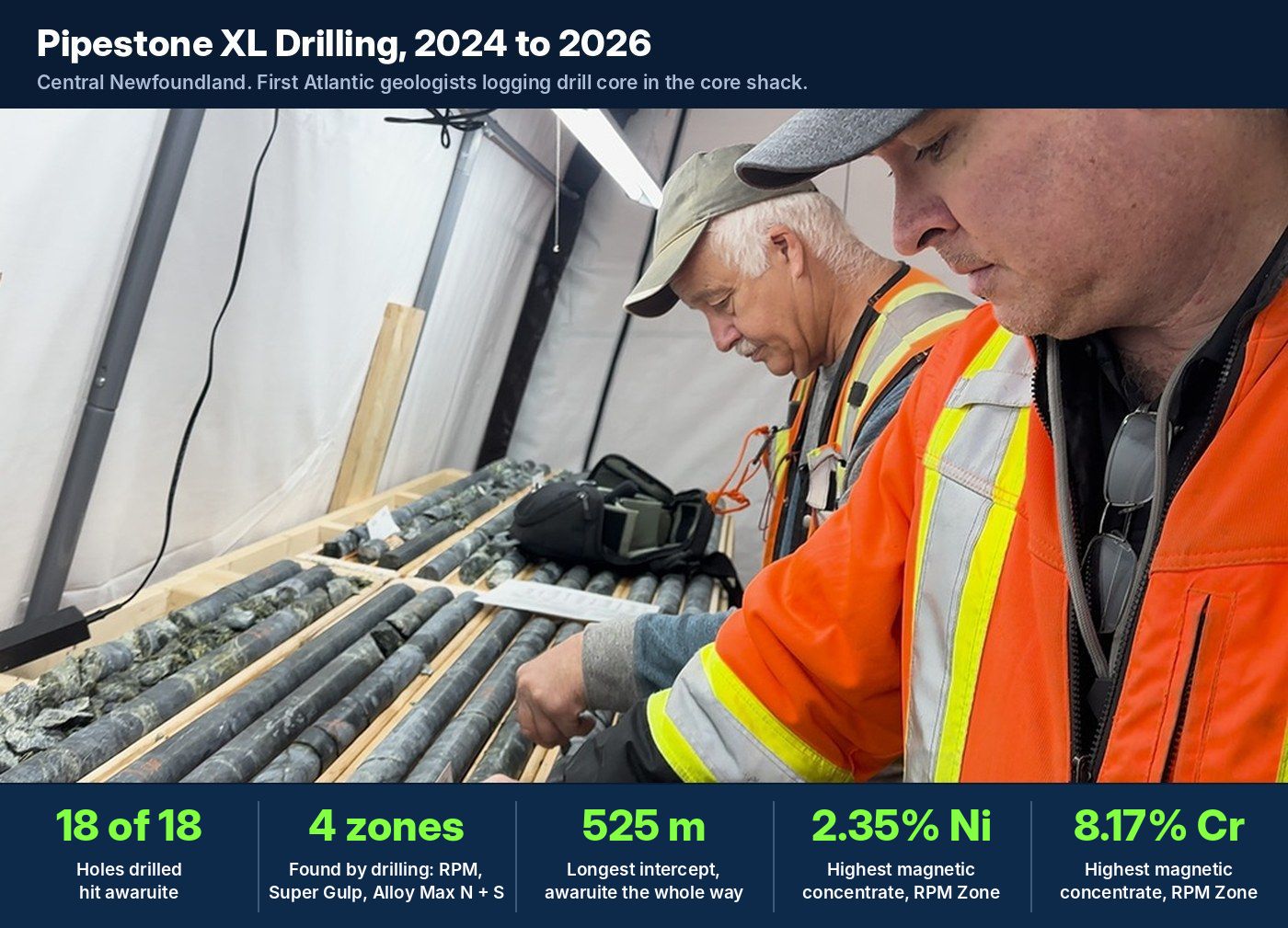
RPM Zone, 2024 and 2025. The first 4 holes, in 2024, had a 100% success rate. In 2025, 9 more expanded RPM to more than 1.2 km of strike and 800 meters of width,[13] with intercepts up to 447 meters and magnetic concentrates grading up to 2.35% nickel (AN-25-06) and 8.17% chromium (AN-24-02).[34][35] All 13 RPM holes returned positive magnetically recoverable awaruite. AN-25-11 ran 0.13% nickel by Davis Tube Recovery, the share of nickel a magnet can recover, over 402 meters, with a magnetic concentrate of 1.31% nickel over the whole interval.[13]
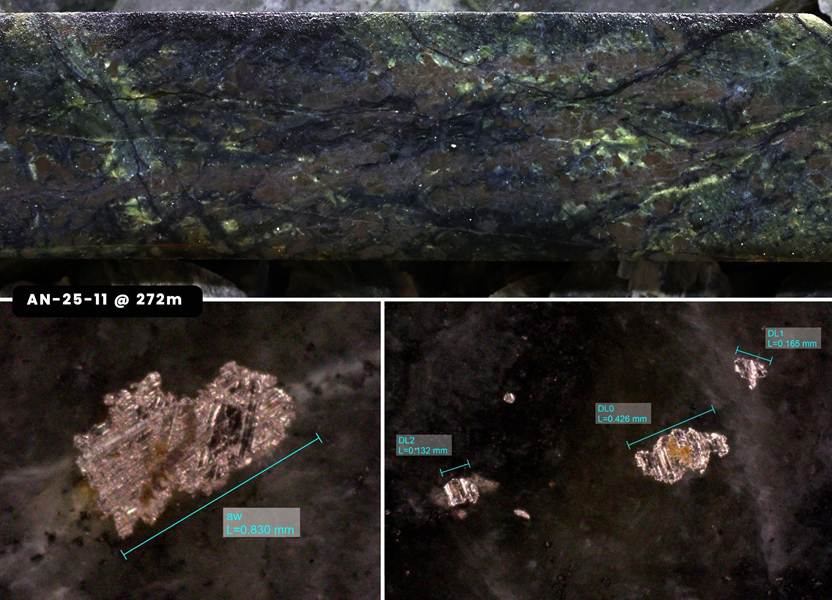
Wide, consistent, disseminated mineralization of this kind is ideal for a large-scale open-pit mine. RPM drill results in order: every reported hole, with the magnetically recoverable (DTR) nickel grade over the full mineralized interval and the grade of the magnetic concentrate the Davis Tube produced. DTR nickel is the nickel a magnet can pull from the rock; the concentrate grade is what that magnetic fraction runs before flotation.[13]
| Hole | Sec. | From | To | Length (m) | DTR Ni % | Conc. Ni % | Reported |
|---|---|---|---|---|---|---|---|
| AN-24-02 | S1 | 11 | 394 | 383 | 0.13 | 1.37 | Mar 12, 2025 |
| AN-24-03 | S1 | 18 | 234 | 216 | 0.11 | 1.32 | Apr 15, 2025 |
| AN-24-04 | S1 | 12 | 378 | 366 | 0.14 | 1.46 | Jun 24, 2025 |
| AN-24-05 | S2 | 6 | 357 | 351 | 0.12 | 1.47 | Jul 9, 2025 |
| AN-25-06 | S2 | 5.65 | 453 | 447 | 0.11 | 1.27 | Aug 12, 2025 |
| AN-25-07 | S2 | 9 | 495 | 486 | 0.09 | 0.97 | Oct 23, 2025 |
| AN-25-08 | S3 | 11 | 491 | 480 | 0.12 | 1.35 | Oct 23, 2025 |
| AN-25-09 | S3 | 9 | 483 | 474 | 0.08 | 0.93 | Dec 2, 2025 |
| AN-25-10 | S1 | 8 | 236 | 228 | 0.15 | 1.44 | Dec 2, 2025 |
| AN-25-11 | S1 | 23 | 425 | 402 | 0.13 | 1.31 | Jan 27, 2026 |
| AN-25-12 | S1 | 10.4 | 95 | 84.6 | 0.10 | 1.24 | Jan 27, 2026 |
| AN-25-13 | S4 | 17 | 388 | 371 | 0.10 | 1.11 | Jan 27, 2026 |
| AN-25-14 | S0 | 8 | 335 | 327 | 0.05 | 0.54 | Jan 27, 2026 |
Source: company news releases, March 12, 2025 to January 27, 2026, as tabulated in the January 27, 2026 release. Intervals are drilled lengths, not true widths.
Alloy Max, 2026. On March 18 the company announced Alloy Max, a second large-scale awaruite target about 7 km north of RPM, mapped at about 4 km long.[36] Drilling has since found awaruite in two areas 2.4 km apart, Alloy Max North and Alloy Max South:
- XL-26-15, June 15, Alloy Max North: the first hole at Alloy Max North, the second large-scale awaruite discovery at Pipestone XL after RPM, hit visible awaruite over its entire 414 meters and ended in mineralization.[37]
- XL-26-16, July 16, Alloy Max North: about 445 meters south, the deepest hole at Pipestone XL hit large-grain visible awaruite over its entire 525 meters.[33]
- XL-26-17, October 13, Alloy Max North: the northernmost hole at Alloy Max North, with grain size increasing downhole to 549 microns at 351 meters, the largest awaruite grain measured at Alloy Max to date.[14]
- XL-26-18, October 13, Alloy Max South: discovery hole of the new Alloy Max South Zone, collared about 2.4 km southwest along strike, with abundant large-grain awaruite from near surface: grains of 331 microns at 15 meters, 273 at 27 meters and 348 at 32 meters.[14]
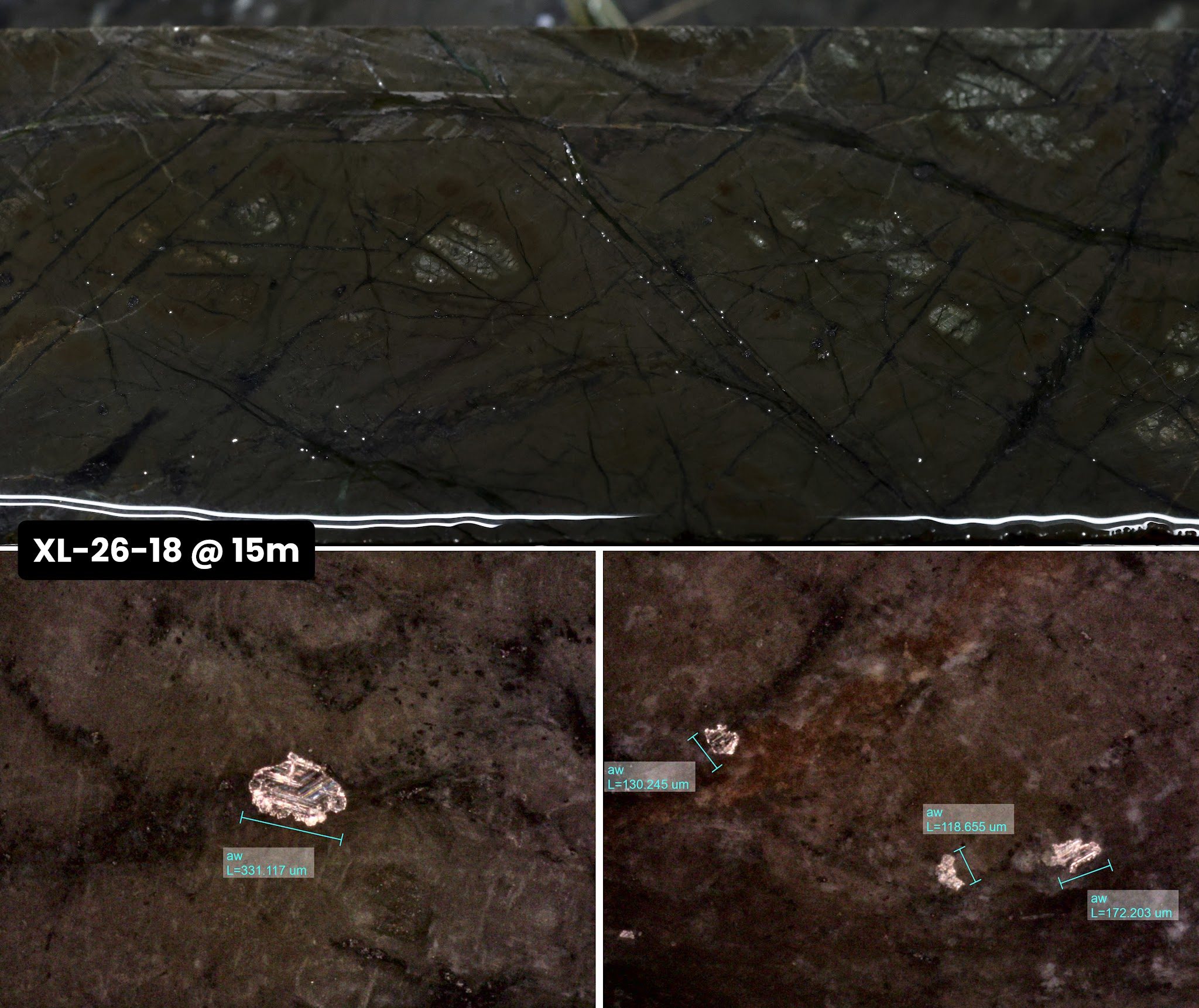
Click the map for a larger, high-resolution view
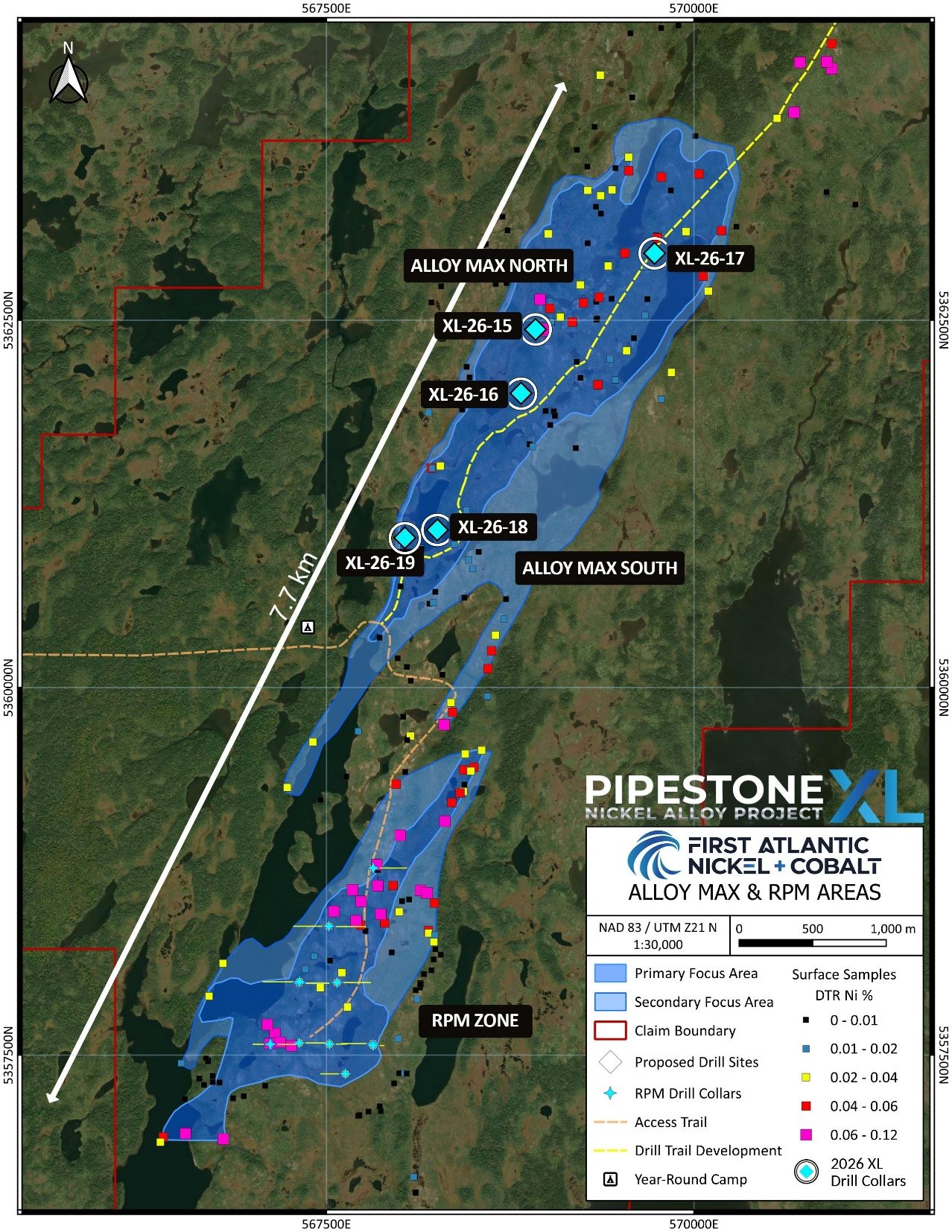
Alloy Max drilling now spans about 2.4 km of strike, XL-26-17 in the north to XL-26-18 in the south, and over 1 km of width, against the 1.2 km by 800 meters drilled at RPM.[14] XL-26-18 ended in visible awaruite at about 40 meters in faulted ground the current rig was not able to advance through; follow-up hole XL-26-19 is testing below it from a new collar, and the company is assessing a larger drill to push deeper.[14]
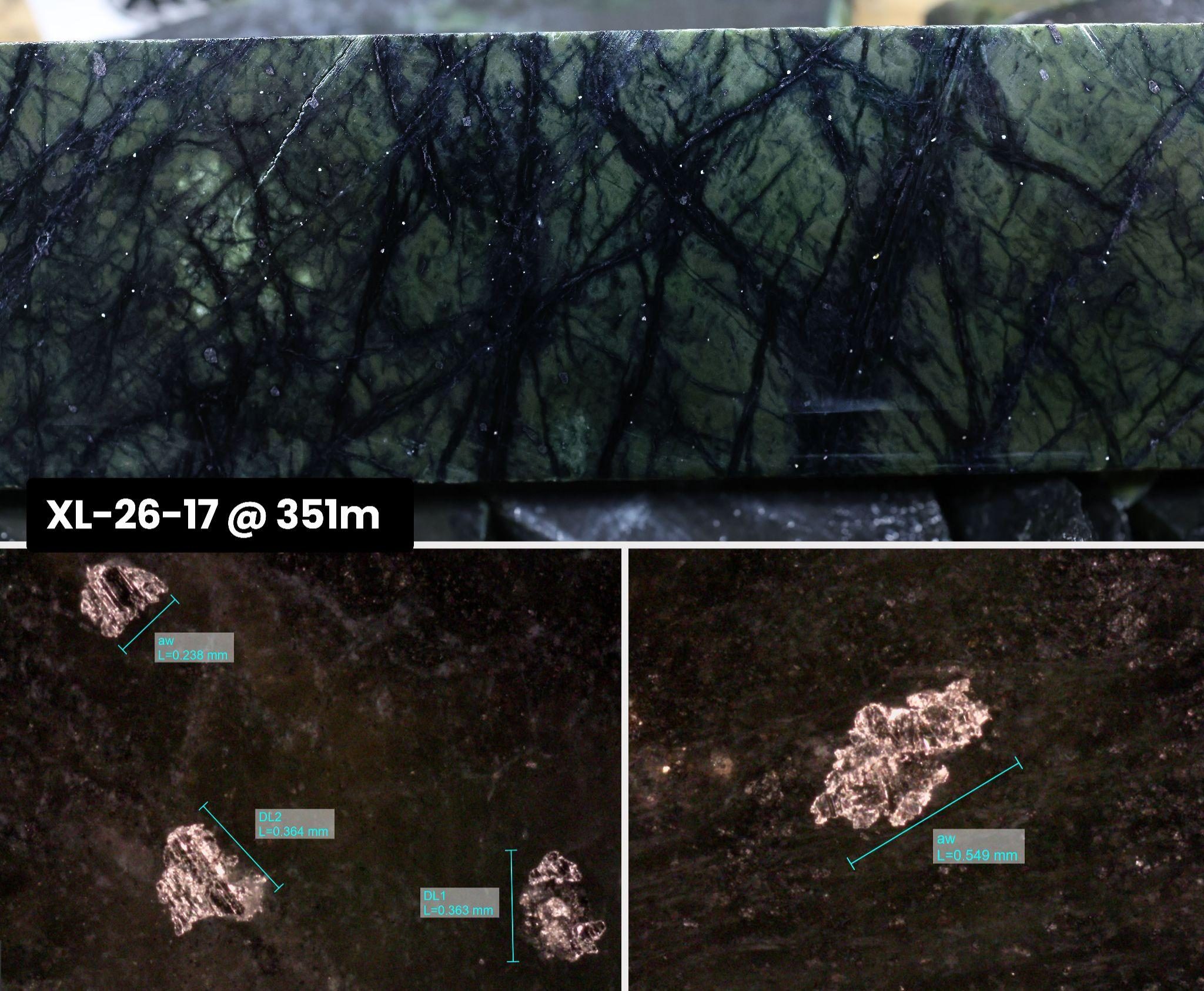
Five zones, potential for multiple pits. Pipestone XL has three new near-surface awaruite discoveries, RPM, Alloy Max North and Alloy Max South, over about 7 km of one 30 km belt, plus the historic Atlantic Lake and Super Gulp zones and the Chrome Pond target.[14] The district model is a chain of large, shallow, magnetically recoverable zones, each a candidate for open-pit, bulk-tonnage mining of the kind iron ore operations run with the same magnetic separator drums, all feeding one central ONSHORE MAX™ concentrator rather than one deposit and one plant.[36] With minimal overburden and road access along the trend, every new zone that drills like RPM or Alloy Max adds a potential pit.[36]
RPM, Alloy Max North and Alloy Max South, all open, and the rest of a 30 km belt still to test: that is the ground First Atlantic is drilling.
Click the map for a larger, high-resolution view
Hydrogen and Chromium: The VEMA Hydrogen Joint Venture and Chromium at Pipestone XL
At First Atlantic’s Ophiolite-X project in the Bay of Islands complex, natural springs discharge hydrogen from active serpentinization, and a study cited by the company puts geologic hydrogen production costs below the U.S. Department of Energy’s $1/kg target.[38]
On June 8, 2026, Vema Hydrogen and First Atlantic signed a non-binding letter of intent for a 50/50 joint venture to develop Engineered Mineral Hydrogen (EMH) at Pipestone XL. Vema runs the world’s first EMH project, in the Thetford ophiolite in Quebec, and lab tests of Pipestone rock at its Orléans facility in France confirmed hydrogen production through stimulated serpentinization.[39]
Following the story? Add OTCQB: FANCF to your watchlist and register for drill results and lab results by email and text as they are released.
Add to watchlist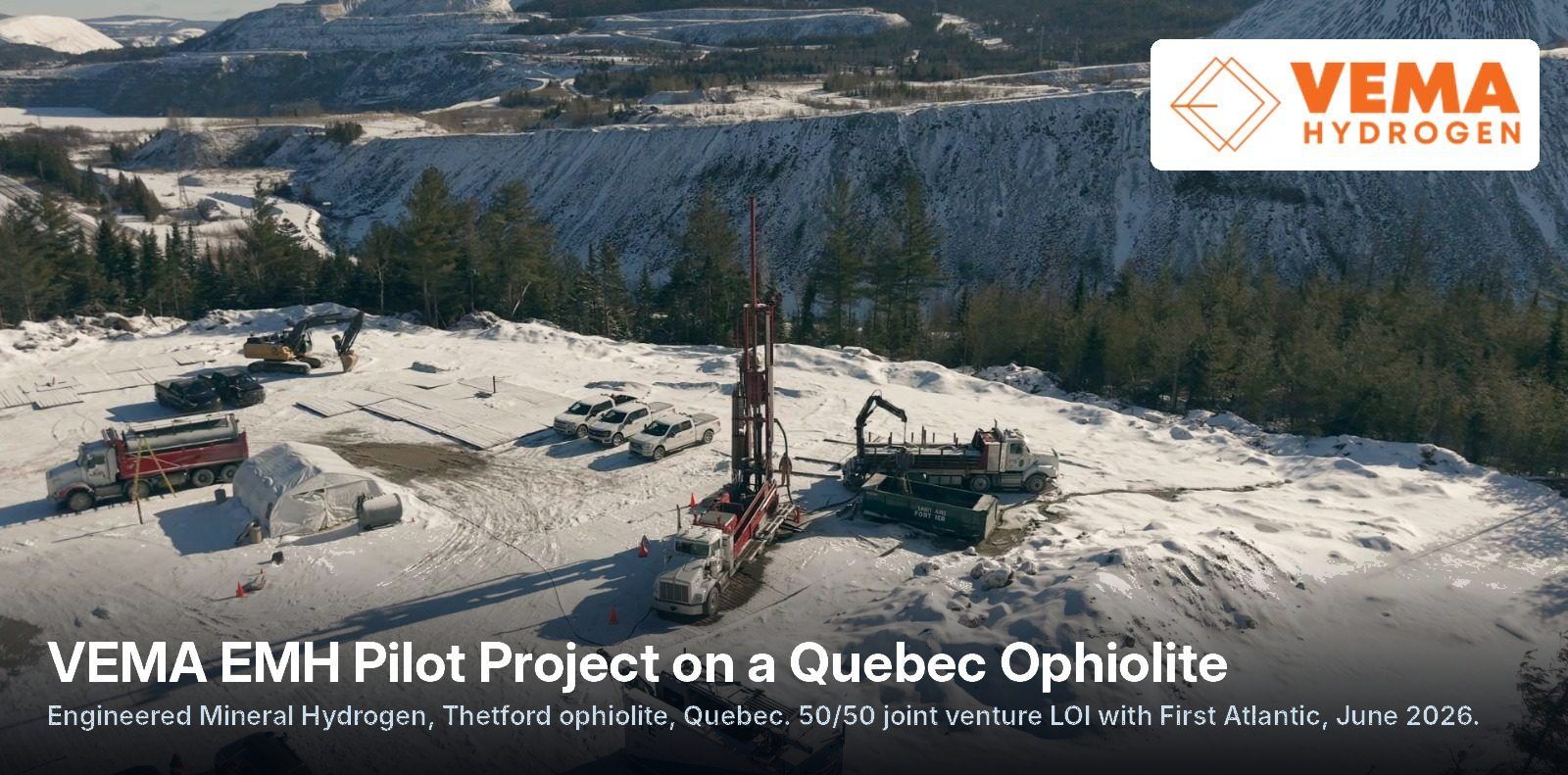
Strategic Advisor, First Atlantic Nickel & Cobalt
Former Program Director, ARPA-E, U.S. Department of Energy

“Vema’s Engineered Mineral Hydrogen is on the verge of delivering clean energy at a scale cost-competitive with hydrocarbons. Awaruite forms through serpentinization when hydrogen reduces nickel and iron, so its presence at Pipestone XL is a clear signature of a hydrogen-rich system. Vema’s technology could engineer that same reaction for hydrogen production, and Pipestone XL is an ideal location due to its size, proximity to infrastructure, and the potential for cost efficiencies in co-locating hydrogen production with nickel & cobalt mining. Having worked closely with Vema’s founders since before the company’s founding, and having seen firsthand how they developed the engineered approach to geologic hydrogen, I believe Pipestone XL represents a compelling opportunity to bring this technology to commercial scale.”[39]
Chromium. Microprobe analysis confirmed the chromium sits in chromite grading 60.2% Cr2O3, and the company is testing ways to recover it as a co-product.[8] The United States has not mined chromium since 1962 and imports 83% of its supply.[40]
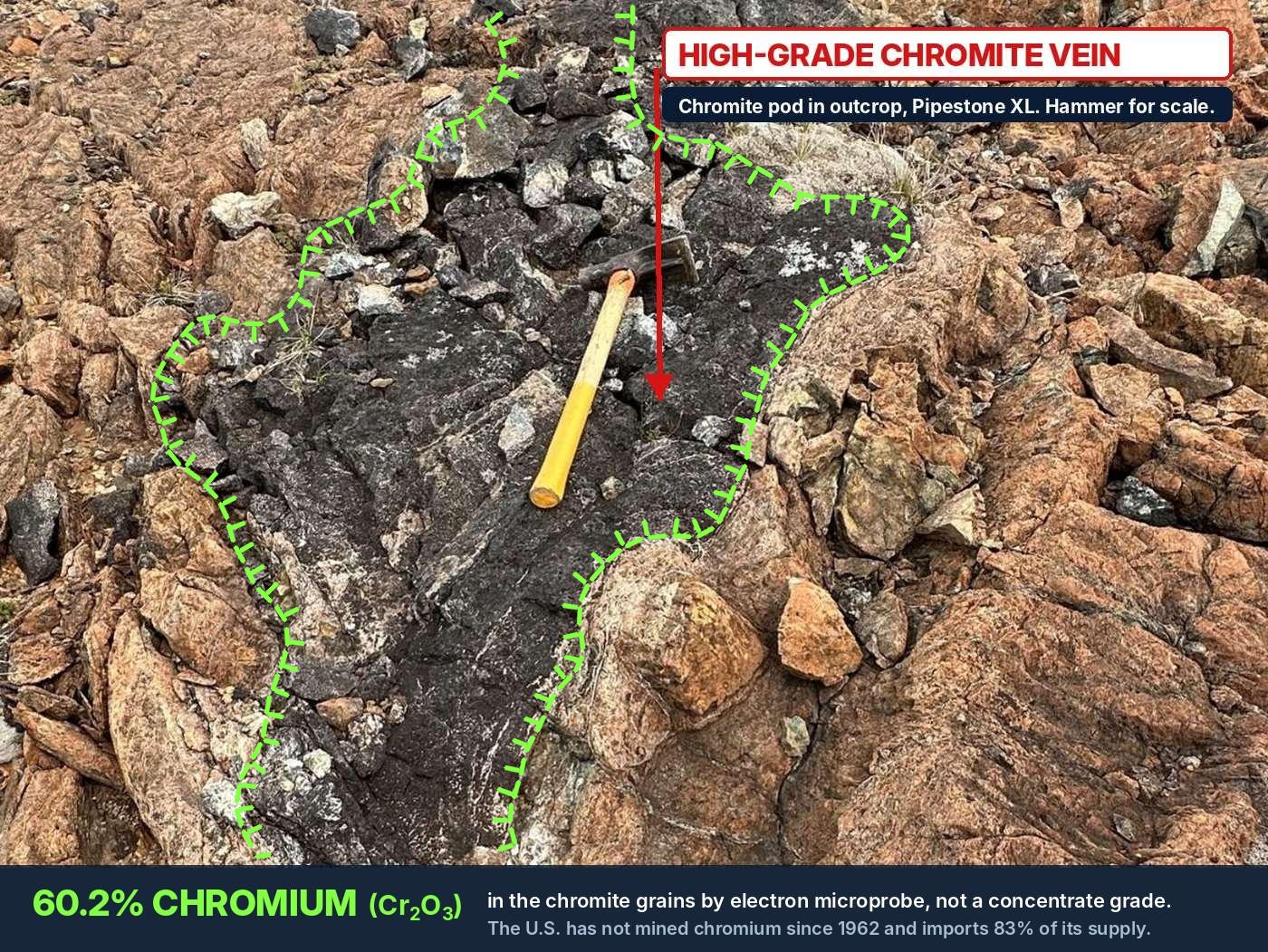
Hydrogen and chromium add two more lines of value to the nickel and cobalt First Atlantic is drilling.
Nickel and Cobalt Demand and China’s Control of Supply: IMF, IEA, Carnegie Endowment and Indonesia
The International Monetary Fund puts accumulated production value from 2021 to 2040 at $4.1 trillion for nickel and $1.6 trillion for cobalt.[41] The International Energy Agency estimates 60 new nickel mines and 17 new cobalt mines will be needed by 2030.[42]
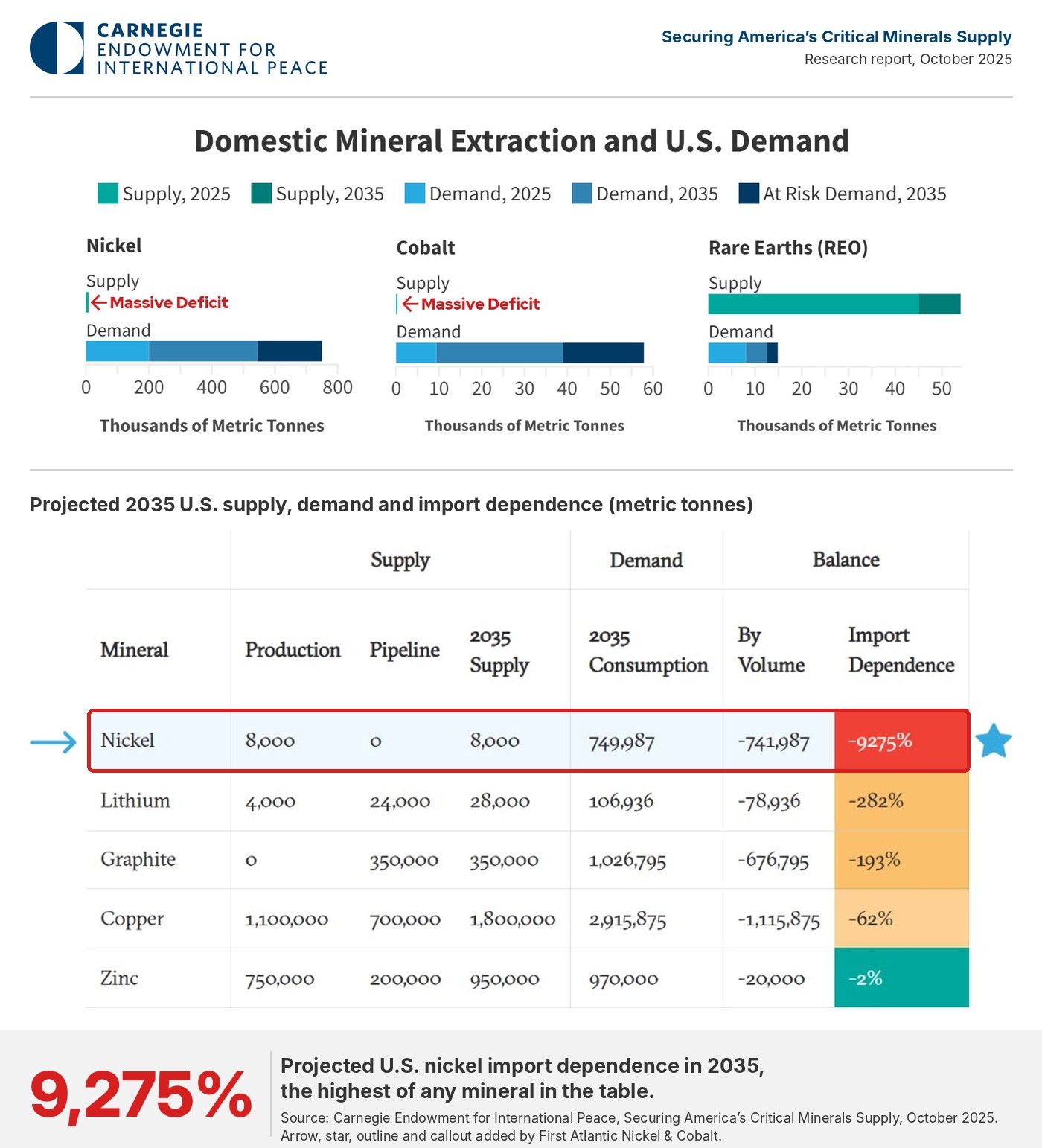
The United States holds less than 1% of global nickel reserves.[19] By 2035 its nickel import reliance is projected at 9,275%, the highest of any critical mineral, according to the Carnegie Endowment for International Peace.[43]
Supply is concentrated where China invests. Indonesia mines more than 60% of the world’s nickel. After it banned raw ore exports in 2020, Chinese state-backed companies invested an estimated $65 billion for near-total control of Indonesian processing, and Indonesia’s own parliament confirmed that China controls 90% of the country’s nickel industry.[44]
First Atlantic Nickel & Cobalt (OTCQB: FANCF, TSX-V: FAN), a nickel-cobalt source in Newfoundland and Labrador processed without a smelter, sits outside that system.
Want to invest? FANCF trades at Schwab, Fidelity and E*TRADE, or ask your own broker.
Why North America Needs Smelter-Free Nickel and Cobalt: Import Reliance, U.S. Permitting Difficulties, Section 45X and the Gigafactory Build-Out
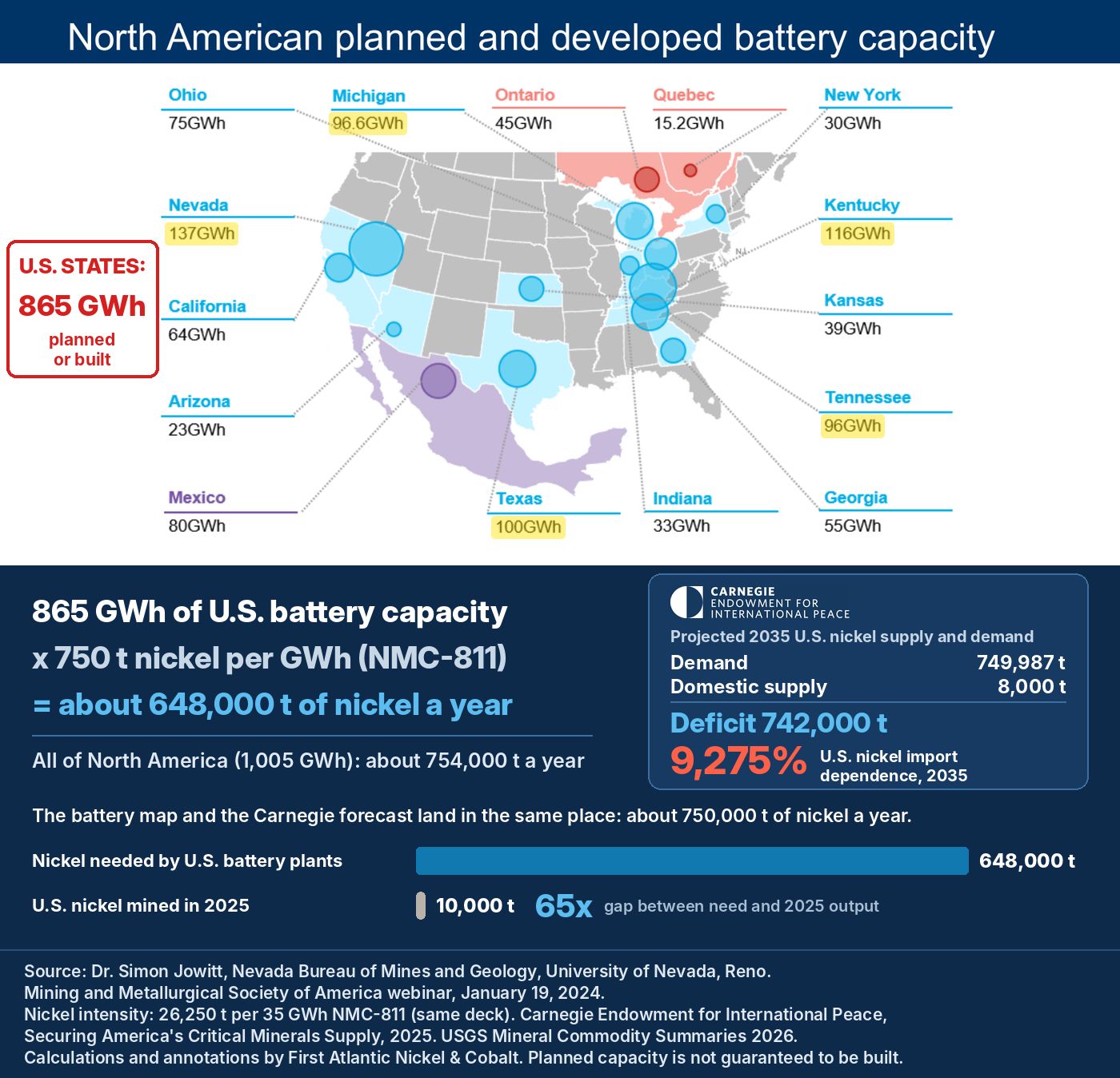
With no nickel smelter on U.S. soil, the United States mines about 10,000 tonnes of nickel a year and, without scrap, is essentially 100% import reliant.[5] The Carnegie Endowment projects U.S. nickel demand at about 750,000 tonnes by 2035 against 8,000 tonnes of domestic supply, a shortfall of roughly 742,000 tonnes and a projected import reliance of 9,275%, the highest of any critical mineral.[43]
Permitting a sulfide mine in the United States is the other obstacle. Sulfide ore generates acid mine drainage when water and air reach the rock, and the acid carries metals such as copper, lead, mercury and arsenic, which the EPA classes as a human carcinogen, into streams.[45][46] That is why the Clean Water Act decides the fate of these projects. The EPA vetoed Pebble in Alaska in January 2023 to protect Bristol Bay salmon, and the owner is still in court against the veto.[47][48] The Army Corps revoked PolyMet’s water permit in Minnesota in June 2023, and in October 2026 the state ordered a new environmental review.[49][50] Twin Metals, on the Duluth Complex that holds about 95% of U.S. nickel reserves and 88% of its cobalt, had its federal leases revoked in 2022, faces a pending state court challenge, and in August 2026 Minnesota paused all mine permitting in the watershed: contested for more than a decade, not a tonne of nickel produced.[51][52][53][54] S&P Global puts the average U.S. mine at 29 years from discovery to production, next to last in the world.[55] Awaruite is sulfur-free, with no acid drainage to permit.
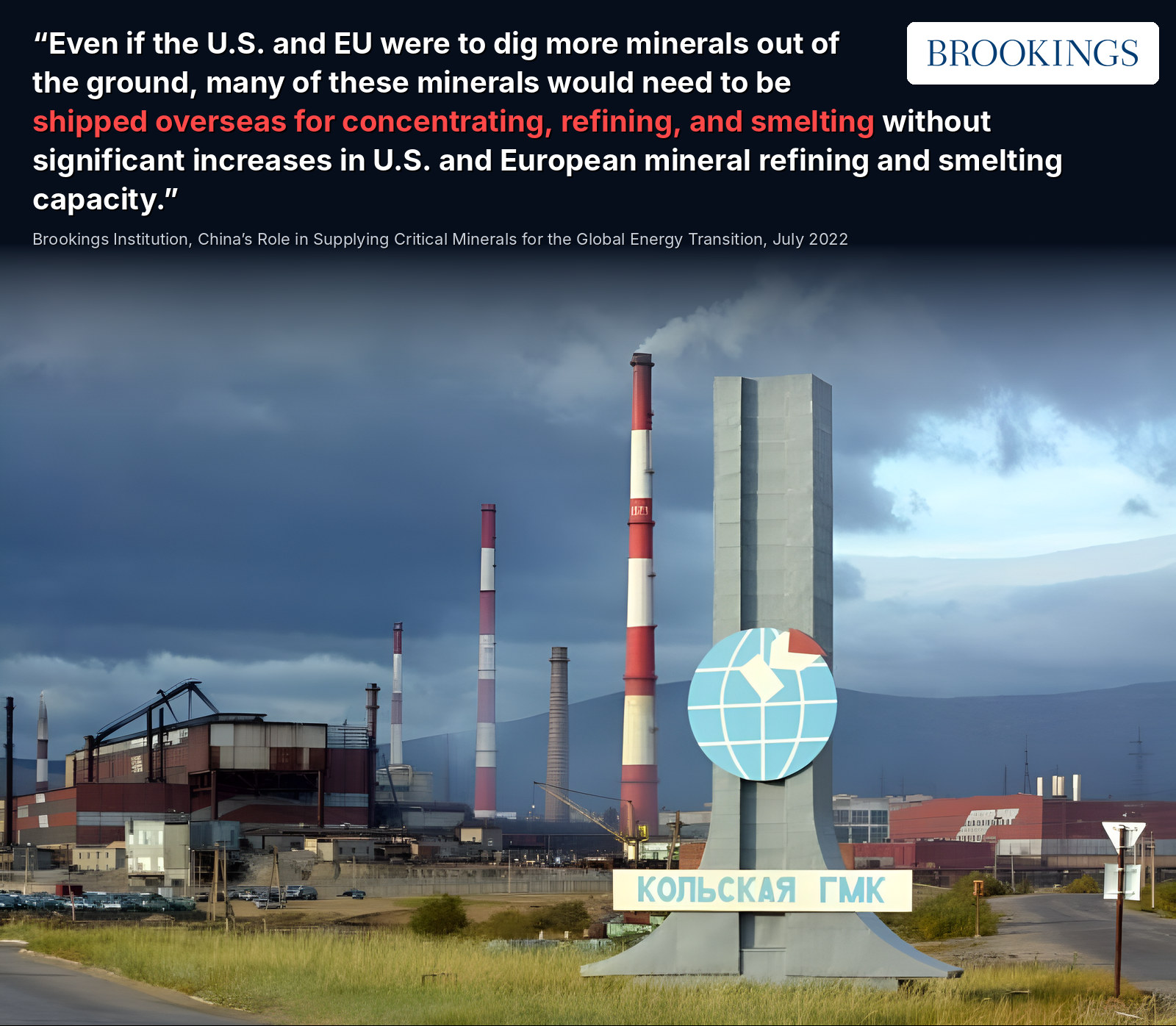
Section 45X, the U.S. Advanced Manufacturing Production Credit, pays a production credit for critical minerals refined in the United States, but for nickel only if the refining happens on U.S. soil.[57] Sulfide nickel must be smelted first; awaruite, already an alloy, can go straight to a U.S. refinery, where nickel sulphate feeds the nickel-based lithium-ion cells Tesla, Panasonic and LG make in the United States.
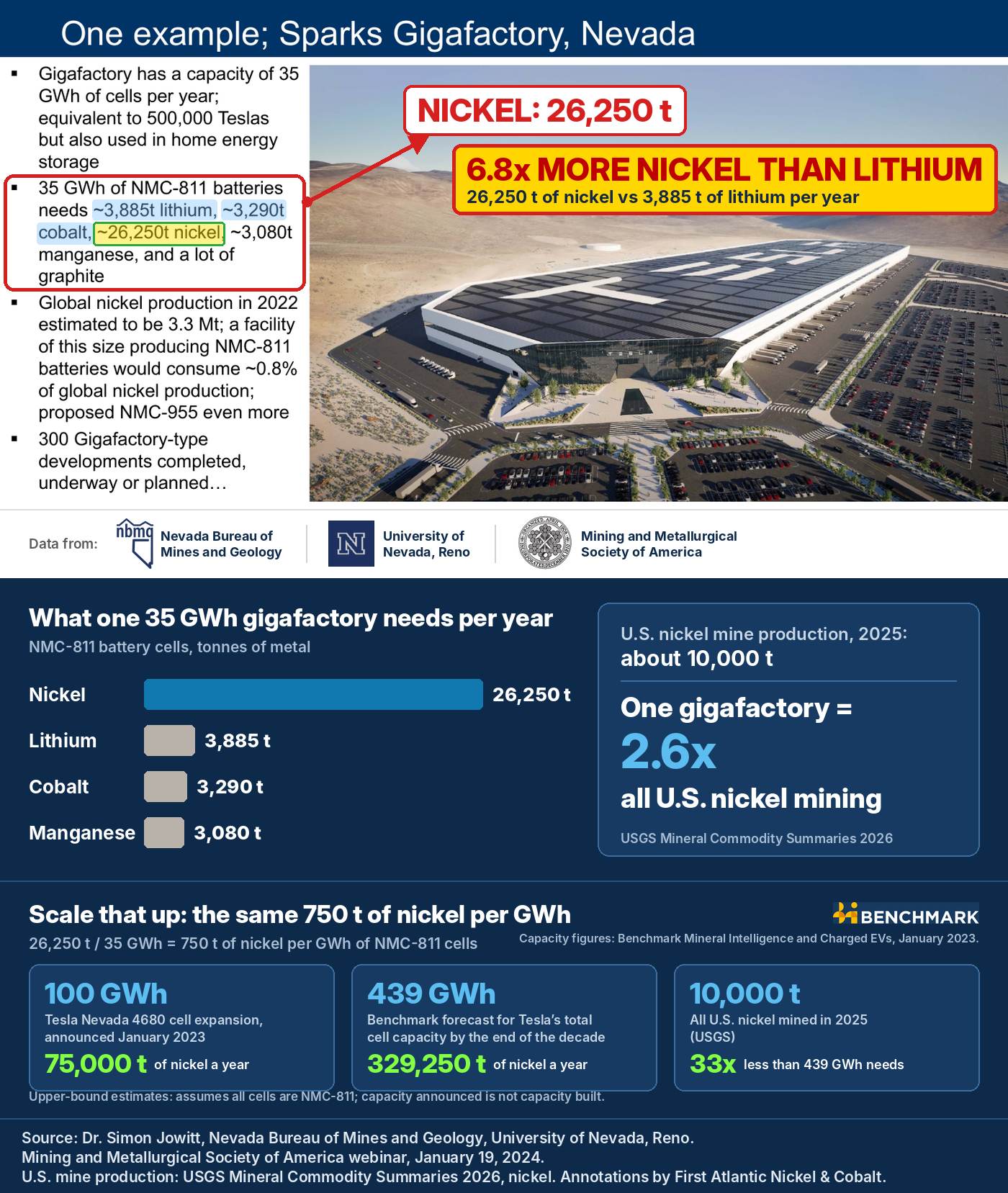
How much nickel does one gigafactory use? One 35 GWh gigafactory, enough cells for about 500,000 Teslas a year, needs roughly 26,250 tonnes of nickel against 3,885 tonnes of lithium and 3,290 tonnes of cobalt, close to 1% of world nickel output for one plant, and some 300 gigafactory-type projects are built, under way or planned.[58] North America’s own battery build-out runs from Nevada and Texas to Kentucky, Tennessee, Michigan, Ohio and Ontario, and none of it has a domestic nickel smelter behind it.[58]
Nickel and cobalt in one alloy, from an allied country, with no smelter: that is what Pipestone XL brings to that gap.
Following the story? Add OTCQB: FANCF to your watchlist and get drill and lab results by email as they are released.
Add to watchlistNewfoundland and Labrador: Top 10 Globally Recognized Mining Jurisdiction, Quick Permitting, Low-Cost Hydro, Deep-Sea Port and U.S. Defense Production Act Domestic-Source Status
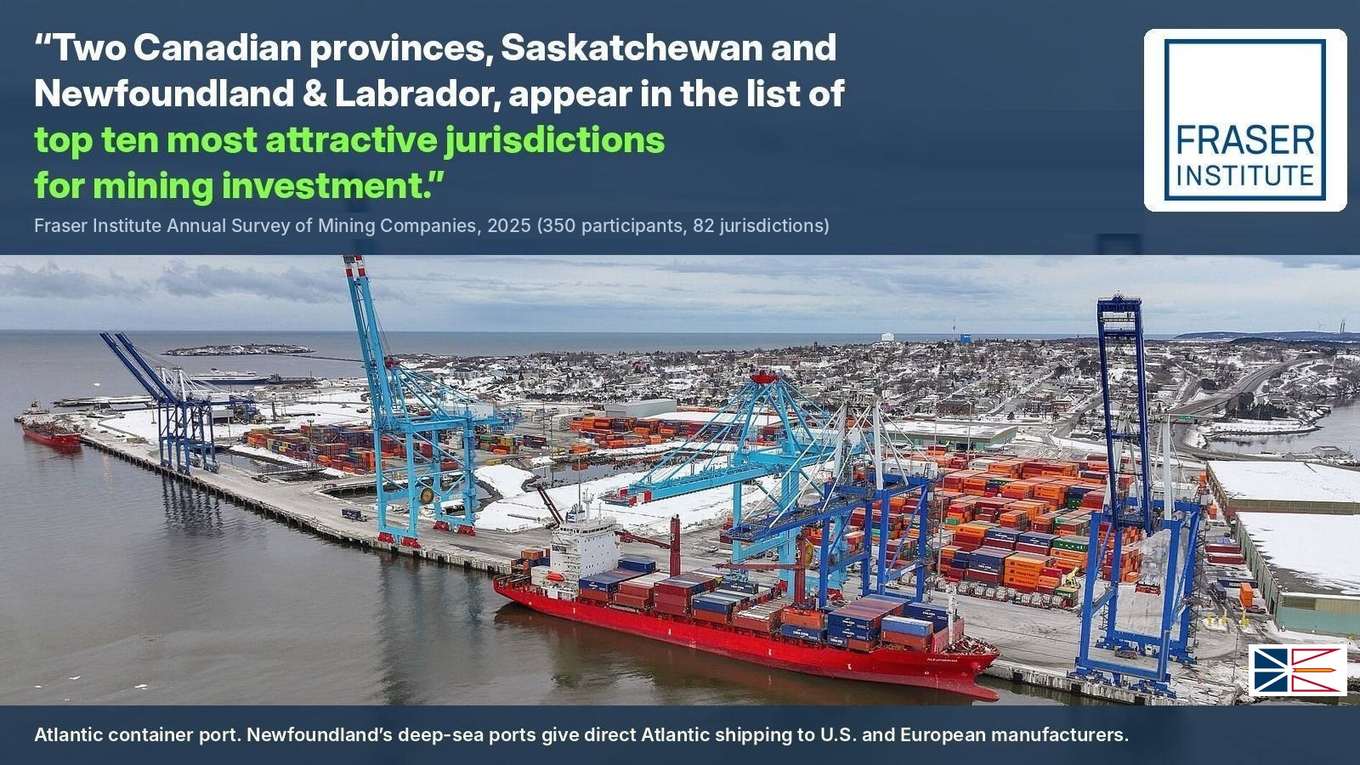
Pipestone XL lies within about 200 km of an international airport and Vale’s Long Harbour nickel plant, with road access to the Trans-Canada Highway.[1][62] The province’s hydro rates are among the cheapest in North America, its deep-sea ports allow direct Atlantic shipping to U.S. and European manufacturers, its projects are among the fastest permitted on the continent, and it is considered a “domestic source” under Title III of the U.S. Defense Production Act.
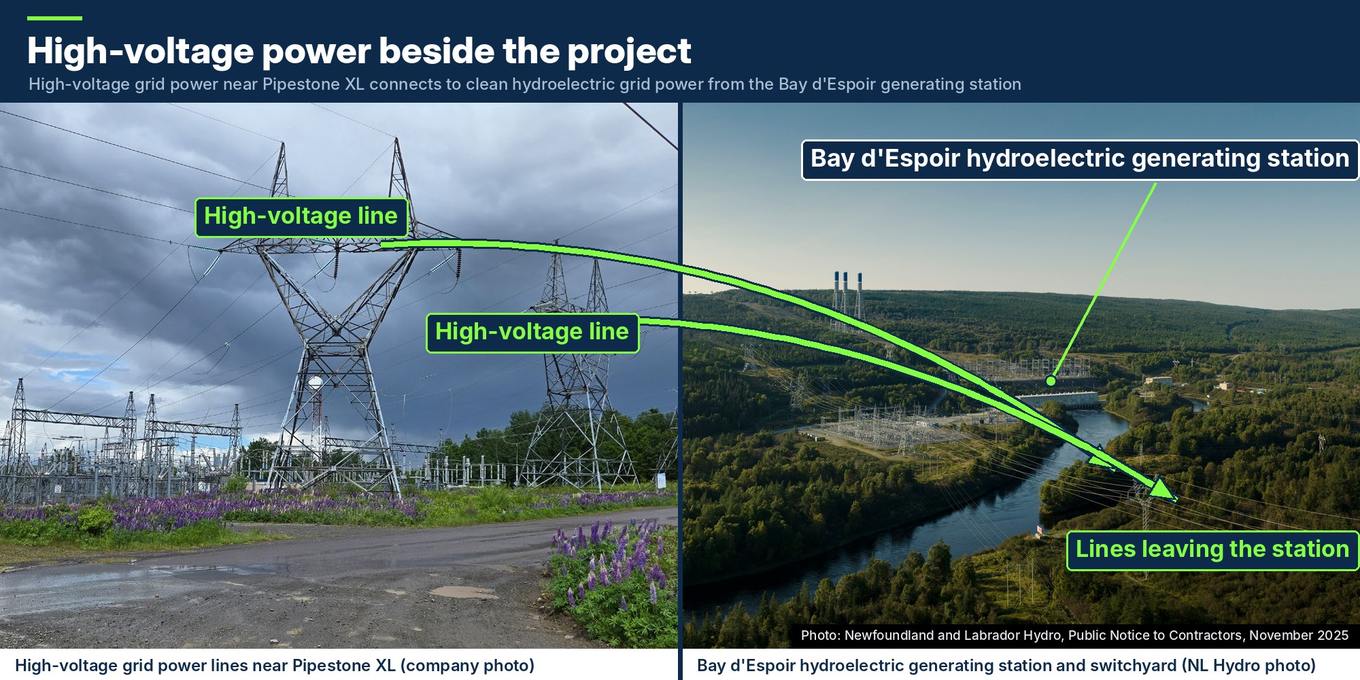
The province has hosted a major nickel-cobalt discovery before: Voisey’s Bay, acquired for $4.3 billion in 1996,[22] and in 2022 Tesla signed a supply deal with Vale for Voisey’s Bay nickel for its North American gigafactories.[63] That is the province’s history, not a forecast for Pipestone XL.
A top-ranked province with road access, cheap power and a deep-sea port is where First Atlantic holds 100% of Pipestone XL.
Management, Advisors and Funding: A P.Geo. CEO, Former Commerce and ARPA-E Officials and $13.4 Million Raised Since September


“North America has limited smelting capacity to meet future nickel and cobalt demand. Pipestone XL is a significant, large-scale ophiolite complex approximately 30 kilometres long, where awaruite occurs disseminated in the ultramafic host rock over large areas. It has the potential to be a large source of both metals without smelting, moving directly into downstream refining and bypassing that midstream processing constraint.”[1]
Adrian Smith, P.Geo., Chief Executive Officer and director, is a geologist with 15 years of mining and exploration experience. He has built and grown resource projects, including one taken from discovery to more than 7 billion tonnes defined within two years, was behind two recent porphyry discoveries in British Columbia and several resource expansions, and has raised millions in equity financing. B.Sc. Geology, Simon Fraser University.[64]
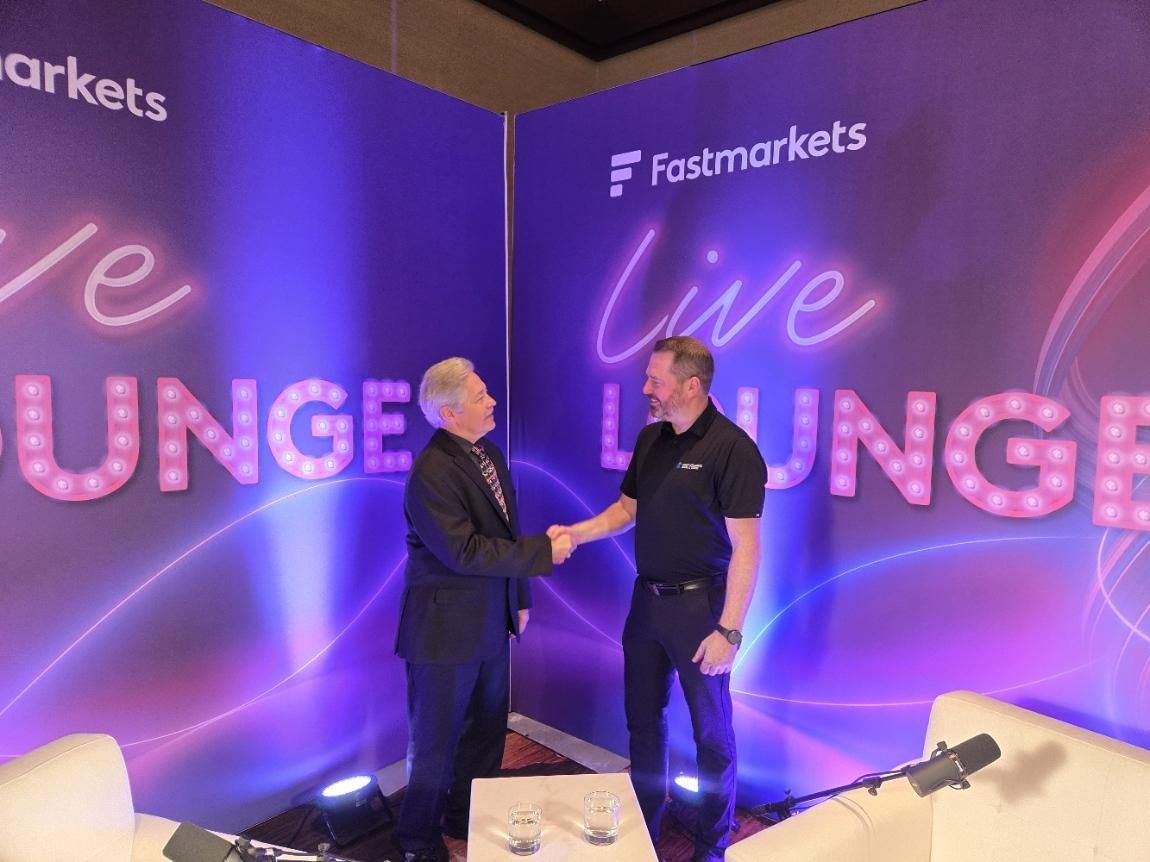
Former Director, Office of Critical Minerals and Metals, U.S. Department of Commerce
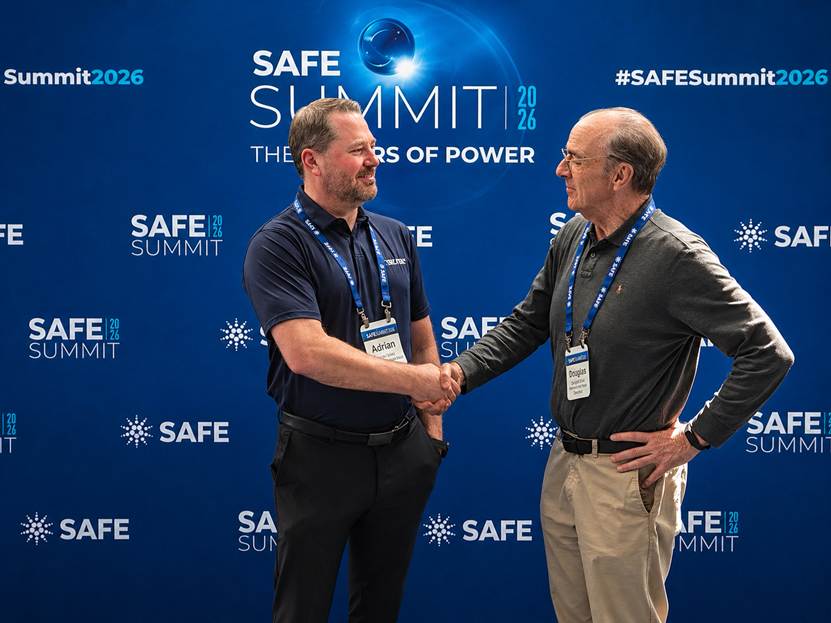
Former Program Director, ARPA-E, U.S. Department of Energy
Gary Stanley, Senior Strategic Advisor, former Director of the Office of Critical Minerals and Metals at the U.S. Department of Commerce and lead author of the 2019 Federal Critical Mineral Strategy.[30]
Dr. Douglas Wicks, Strategic Advisor, former ARPA-E Program Director at the U.S. Department of Energy, where he led the MINER program and geologic hydrogen work.[31]
Funding. Since September 2026, First Atlantic has raised about $13.4 million in three no-warrant private placements, the latest at a premium of about 22% to market.[1]
A geologist CEO who has taken a discovery to a defined deposit before, Washington critical minerals experience at his side and a funded drill program: that is the team behind First Atlantic.
How to Invest Early in FANCF: Three Ways to Follow First Atlantic Nickel & Cobalt and Pipestone XL
In 2026 the nickel price fell[11] and the Sprott Nickel Miners ETF fell further,[12] while First Atlantic’s shares rose.[10] The difference is the processing route and the 2026 results, not the metal price. Past performance is not indicative of future results.
Large Nickel Discoveries Can Be Worth Billions of Dollars
What nickel discoveries have sold for. Four nickel acquisitions, as announced and in 2026 dollars, set against First Atlantic’s market cap of about C$120 million. Each company and project is different, and past transactions are not a prediction of any future transaction or of First Atlantic’s value.
Questions about investing in First Atlantic Nickel & Cobalt?
Call Investor Relations, Rob Guzman: 1-844-592-6337
Look up FANCF at your broker.
First Atlantic trades in the U.S. on the OTCQB under FANCF and in Canada on the TSX Venture Exchange under FAN. Search the symbol at Schwab, Fidelity, E*TRADE or your own broker.
Add FANCF to your watchlist.
Follow the share price and the news as XL-26-19 tests below the Alloy Max South discovery and bulk sample work advances at RPM.
Get free email and text alerts.
Sign up below and drill results and lab results come to you by news release.
FANCF: Register for Investor Email and SMS Updates
Drill results and lab results come out by news release. You can stop the alerts at any time.
Pipestone XL is a smelter-free North American source of nickel and cobalt, held 100% by First Atlantic Nickel & Cobalt Corp. (OTCQB: FANCF | TSX-V: FAN).
Rob Guzman
Investor Relations, First Atlantic Nickel & Cobalt Corp.
1-844-592-6337 | rob@fanickel.com

Investor Relations: Robert Guzman | 1-844-592-6337 | ir@fanickel.com
First Atlantic Nickel & Cobalt Corp.
Suite 1890, 1075 West Georgia Street
Vancouver, British Columbia V6E 3C9, Canada
ir@fanickel.com
fanickel.com | News releases | Facebook | X | LinkedIn
Sources
- https://fanickel.com/20261006-first-atlantic-nickel-cobalt-raises-total-of-13-4-million-with-additional-3-49-million-no-warrant-non-brokered-private-placement-at-0-83-per-share-a-premium-to-market-to-accelerate-exploration-at-pipestone-xl-nickel-cobalt-alloy-project
- https://fanickel.com/20260619-first-atlantic-nickel-cobalt-highlights-g7-leaders-declaration-on-critical-minerals-g7-names-nickel-one-of-only-two-pilot-minerals-for-a-new-allied-traceability-framework-moves-to-mobilize-equity-investment-and-offtake-and-establishes-a-critical-
- https://www.whitehouse.gov/presidential-actions/2026/01/adjusting-imports-of-processed-critical-minerals-and-their-derivative-products-into-the-united-states/
- https://fanickel.com/20260825-first-atlantic-nickel-cobalt-attends-the-defense-industrial-base-accelerator-dibx-2026-showcasing-awaruite-ni-fe-co-alloy-samples-processed-with-onshore-max-into-an-alloy-concentrate-up-to-71-9-nickel-and-1-76-cobalt-from-the-pipestone-xl-project
- https://pubs.usgs.gov/periodicals/mcs2026/mcs2026-nickel.pdf
- https://www.cbc.ca/news/canada/manitoba/thompson-refinery-shutting-down-1.896396
- https://www.permits.performance.gov/permitting-project/fast-41-covered-projects/project-crucible
- https://fanickel.com/20260521-first-atlantic-nickel-cobalt-reports-electron-microprobe-analysis-returning-77-62-nickel-and-1-69-cobalt-in-awaruite-at-the-rpm-zone-pipestone-xl-project-a-rare-naturally-magnetic-ni-fe-co-high-grade-alloy-mineralogically-capable-of-bypassing-mid
- https://fanickel.com/20260624-first-atlantic-nickel-cobalt-produces-high-grade-alloy-concentrate-up-to-71-9-nickel-and-1-76-cobalt-from-its-pipestone-xl-nickel-cobalt-alloy-project-using-its-first-ever-onshore-max-magnetic-alloy-extraction-recovery-concentration-process-unvei
- https://finance.yahoo.com/quote/FAN.V/history/
- https://www.westmetall.com/en/markdaten.php?action=table&field=LME_Ni_cash
- https://finance.yahoo.com/quote/NIKL/history/
- https://fanickel.com/20260127-first-atlantic-nickel-increases-rpm-zone-strike-length-50-to-over-1-2-km-and-width-to-over-800-m-from-phase-2x-drilling-at-pipestone-xl-magnetic-nickel-cobalt-alloy-project
- https://fanickel.com/20261013-first-atlantic-nickel-cobalt-drills-first-discovery-hole-at-alloy-max-south-zone-with-drill-hole-xl-26-18-best-near-surface-visible-awaruite-to-date-at-alloy-max-ending-in-open-mineralization-xl-26-17-extends-alloy-max-north-drilling-now-spans-2-
- https://fanickel.com/20260331-first-atlantic-nickel-announces-acceptance-into-defense-industrial-base-consortium-dibc---pipestone-xl-smelter-free-nickel-cobalt-alloy-project-addresses-midstream-smelting-bottleneck-in-u-s--defense-supply-chain
- https://www.govinfo.gov/content/pkg/FR-2025-06-09/html/2025-10524.htm
- https://www.thompsoncoburn.com/insights/trump-administration-issues-proclamation-imposing-50-section-232-tariffs-export-controls-on-some-copper-scrap/
- https://www.federalregister.gov/documents/2026/01/20/2026-01045/adjusting-imports-of-processed-critical-minerals-and-their-derivative-products-into-the-united
- https://www.csis.org/analysis/trade-critical-supply-chains
- https://www.cassidylevy.com/news/modified-full-value-section-232-metal-tariffs-announced/
- https://d9-wret.s3.us-west-2.amazonaws.com/assets/palladium/production/mineral-pubs/nickel/mcs-2012-nicke.pdf
- https://publications.gc.ca/Pilot/LoPBdP/BP/bp422-e.htm
- https://fanickel.com/20260427-first-atlantic-nickel-announces-name-change-to-first-atlantic-nickel--cobalt-ahead-of-the-washington-dc-safe-summit-reinforcing-the-natural-cobalt-content-of-awaruite---a-rare-naturally-magnetic-ni-fe-co-alloy-that-is-sulfur-free-and-can-bypass-m
- https://transitionaccelerator.ca/wp-content/uploads/2025/08/From-Rocks-to-Power-Nickel.pdf
- https://www.defense.gov/News/Releases/Release/Article/3522652/department-of-defense-enters-an-agreement-to-strengthen-the-us-supply-chain-for/
- https://www.batteriesinternational.com/news/7bn-us-super-smelter-project-clears-environmental-hurdle/
- https://en.sedaily.com/finance/2026/09/21/korea-zincs-74-billion-us-smelter-clears-environmental
- https://youngkim.house.gov/2026/06/08/reps-kim-bera-dominance-act-passes-u-s-house-of-representatives/
- https://fanickel.com/20260611-first-atlantic-highlights-u-s-dominance-act-passed-by-house-new-critical-minerals-bill-authorizes-equity-investment-co-financing-and-u-s-priority-offtake-for-allied-projects-and-defines-processed-as-a-metal-metal-powder-or-a-master-alloy-awaruite
- https://fanickel.com/20260630-first-atlantic-nickel-cobalt-welcomes-former-director-of-the-office-of-critical-minerals-and-metals-at-the-united-states-department-of-commerce-gary-stanley-as-senior-strategic-advisor
- https://fanickel.com/20260429-first-atlantic-nickel--cobalt-welcomes-dr--douglas-wicks-former-program-director-for-the-u-s--department-of-energys-arpa-e-advanced-research-projects-agency-energy-miner-program-and-geologic-hydrogen-portfolio-as-strategic-advisor
- https://www.fanickel.com/20241029-first-atlantic-nickel-drills-wide-interval-of-visible-disseminated-awaruite-nickel-at-super-gulp-target-new-discovery-16-km-south-of-historical-drilling-at-atlantic-lake
- https://fanickel.com/20260716-first-atlantic-nickel-cobalt-expands-alloy-max-zone-445-meters-south-of-the-discovery-hole-xl-26-16-the-deepest-hole-to-date-at-pipestone-xl-intersects-large-grain-visible-awaruite-ni-fe-co-alloy-over-its-entire-525-meter-length-ending-in-open-mi
- https://fanickel.com/20250813-first-atlantic-nickel-reports-initial-phase-2-drill-results-deepest-drill-hole-to-date-at-rpm-zone-returns-1-27-awaruite-nickel-alloy-nife-in-magnetic-concentrate-over-447-meters
- https://fanickel.com/20250313-first-atlantic-nickel-releases-initial-dtr-metallurgical-results-magnetic-concentrate-of-1-37-nickel--1-73-chromium-over383-1metres
- https://fanickel.com/20260318-first-atlantic-nickel-announces-new-alloy-max-zone-discovery---a-second-large-scale-awaruite-nife-target-area-extending-7-km-north-from-the-rpm-zone-at-the-pipestone-xl-nickel-cobalt-alloy-project
- https://fanickel.com/20260615-first-atlantic-nickel-drills-second-large-scale-awaruite-ni-fe-co-alloy-discovery-at-alloy-max-north-pipestone-xl-project-5-2-km-north-of-rpm-zone-visible-awaruite-over-414-meter-drill-hole-ending-in-open-mineralization
- https://fanickel.com/20251211-first-atlantic-nickel-acquires-ophiolite-x-project-targeting-white-and-orange-geologic-hydrogen-carbon-capture-and-critical-minerals-in-westernnewfoundland
- https://fanickel.com/20260608-vema-hydrogen-and-first-atlantic-nickel-cobalt-sign-loi-to-develop-engineered-mineral-hydrogen-at-pipestone-xl-awaruite-project-in-newfoundland
- https://www.mbmg.mtech.edu/pdf-publications/fs34.pdf
- https://www.imf.org/-/media/files/publications/wp/2021/english/wpiea2021243-print-pdf.pdf
- https://www.mining.com/hundreds-of-new-mines-required-to-meet-2030-battery-metals-demand-iea-report/
- https://carnegieendowment.org/research/2025/10/securing-americas-critical-minerals-supply
- https://globalvoices.org/2025/04/07/how-chinas-investment-in-indonesias-nickel-industry-is-impacting-local-communities/
- https://www.usgs.gov/mission-areas/water-resources/science/mine-drainage
- https://www.epa.gov/sites/default/files/2021-04/documents/arsenic_april_2021.pdf
- https://epa.gov/bristolbay/final-determination-pebble-deposit-area
- https://www.sec.gov/Archives/edgar/data/0001164771/000165495426007531/ndm_ex992.htm
- https://www.fox9.com/news/newrange-copper-nickel-mine-us-army-corps-revokes-permit-cites-threat-to-mn-tribes-water-standards
- https://www.kaxe.org/local-news/2026-10-08/proposed-northmet-changes-require-additional-environmental-review-dnr-says
- https://www.savetheboundarywaters.org/memo-dispelling-twin-metals-critical-minerals-fiction
- https://www.congress.gov/bill/119th-congress/house-joint-resolution/140
- https://www.fox9.com/news/bwca-mining-ban-ends-trump-april-2026
- https://queticosuperior.org/governor-walz-issues-executive-order-aimed-at-blocking-copper-nickel-mining-near-the-boundary-waters/
- https://press.spglobal.com/2024-07-18-United-States-Ranks-Next-to-Last-in-Development-Time-for-New-Mines-that-Produce-Critical-Minerals-for-Energy-Transition%2C-S-P-Global-Finds
- https://www.brookings.edu/wp-content/uploads/2022/08/LTRC_ChinaSupplyChain.pdf
- https://www.federalregister.gov/d/2023-27498/p-460
- https://mmsa.net/wp-content/uploads/2024/01/Jowitt-MMSA-Webinar-January-2023-v2_nohide.pdf
- https://source.benchmarkminerals.com/article/tesla-takes-on-byds-crown-with-100-gwh-nevada-expansion
- https://chargedevs.com/newswire/tesla-to-build-semis-and-expand-battery-production-at-nevada-gigafactory/
- https://www.fraserinstitute.org/studies/annual-survey-mining-companies-2024
- https://fanickel.com/20260408-first-atlantic-nickel-commences-drilling-at-new-alloy-max-zone-discovery-7-km-north-of-rpm-zone-at-the-pipestone-xl-nickel-cobalt-alloy-project
- https://vale.com/w/vale-confirms-supply-deal-with-tesla-for-low-carbon-nickel
- https://www.fanickel.com/
- https://www.lexpert.ca/big-deals/norilsk-nickel-acquires-lionore-mining-for-68b/346316
- https://en.wikipedia.org/wiki/Cosmos_Nickel_Mine
- https://www.sbs.com.au/news/article/wa-miners-in-1-8b-takeover-deal/uxvrrzuy3
- https://www150.statcan.gc.ca/n1/pub/62-001-x/2016007/t040-eng.htm
Disclaimer
This webpage has been prepared and distributed by First Atlantic Nickel & Cobalt Corp. and constitutes a promotional communication. It is provided for informational purposes only and does not constitute financial or investment advice or a recommendation, offer or solicitation to buy or sell any securities. Investing in securities involves risk, including the risk of loss of principal. Past performance is not indicative of future results, and no assurance can be given that any objectives, projections or expectations described on this page will be achieved. Market forecasts cited on this page are third-party views and are inherently uncertain; actual price and demand outcomes may differ materially.
No securities regulator or stock exchange has reviewed or accepts responsibility for its contents. Recipients should conduct their own research and consult qualified investment professionals before making any investment decisions. By reading this communication, you acknowledge and agree that neither First Atlantic Nickel & Cobalt Corp. nor any of its directors, officers, employees, agents, or promoters accepts any liability for any direct or consequential loss or damages arising from reliance on the information contained herein.
Scientific and Technical Information
The scientific and technical information on this page has been reviewed and approved by Adrian Smith, director and the Chief Executive Officer of the Company whom is a qualified person as defined by NI 43-101. The qualified person is a member in good standing of the Professional Engineers and Geoscientists Newfoundland and Labrador (PEGNL) and is a registered professional geoscientist (P.Geo.). Unless otherwise indicated, the technical information on this page is derived from the Company's previously filed disclosure, including news releases available under the Company's profile on SEDAR+.
Forward-Looking Information
This page contains "forward-looking information" within the meaning of applicable Canadian securities laws, including, without limitation, statements regarding: anticipated North American and U.S. demand for nickel, cobalt and chromium; projected supply deficits, import dependence and price trends; the potential strategic importance of the Pipestone XL Project; the potential for awaruite mineralization to support smelter-free or onshore processing; the potential ability of concentrate from the Project to be processed by downstream North American customers; expected metallurgical, recovery, concentrate grade, by-product and processing outcomes; the extent, scale and continuity of mineralization; future exploration, drilling, metallurgical testing and development plans; permitting, environmental, infrastructure and timeline advantages; and potential opportunities relating to chromium, geologic hydrogen and carbon capture. Forward-looking information is often, but not always, identified by words such as "expects," "plans," "targets," "believes," "projects," "potential," "could," "may," "will," "anticipates," and similar expressions.
Forward-looking information on this page is based on a number of material factors and assumptions, including, among other things: the accuracy of current geological, geophysical, geochemical, drilling, sampling, assay and metallurgical data interpretations; the continuation of observed mineralization and metallurgical characteristics; the ability to obtain results from additional drilling and testing consistent with results to date; the availability of financing, personnel, equipment and contractor support; the timely receipt of permits, approvals and access; the availability of infrastructure, processing, refining and transportation alternatives; the continuation of supportive critical mineral, trade and industrial policies in Canada and the United States; and management's current expectations regarding market conditions, demand, pricing and supply chain dynamics for nickel, cobalt and chromium.
Forward-looking information is subject to known and unknown risks, uncertainties and other factors that may cause actual results or events to differ materially from those expressed or implied by such forward-looking information. These include, without limitation: exploration results not supporting current interpretations; drilling, sampling, assay, metallurgical or recovery results that differ from results obtained to date; the absence of a mineral resource estimate or economic study demonstrating economic viability; changes in commodity prices, demand forecasts, tariffs, quotas, trade measures or critical mineral policies; the inability to secure financing, permits, social licence, infrastructure, contractors, processing arrangements or offtake relationships on acceptable terms or at all; technical, engineering, processing, scale-up or recovery challenges; cost inflation; environmental and regulatory risks; title, access, weather and operational risks; and general economic, market and capital markets conditions. Readers are cautioned that actual results may differ materially from the forward-looking information on this page, and undue reliance should not be placed on such information.
The forward-looking information on this page is made as of the date of publication of this page, and First Atlantic Nickel & Cobalt Corp. undertakes no obligation to update or revise such information except as required by applicable securities laws.
Readers should review the Company's continuous disclosure filings available on SEDAR+ and should conduct their own independent review before making any investment decision.
© 2026 First Atlantic Nickel & Cobalt Corp. | TSX-V: FAN | OTCQB: FANCF | FSE: P210
First Atlantic Nickel & Cobalt Corp., Suite 1890, 1075 West Georgia Street, Vancouver, British Columbia V6E 3C9, Canada. Investor Relations: 1-844-592-6337, ir@fanickel.com.