First Atlantic Nickel & Cobalt Corp. Featured in Financial Post Article
Progressing towards a feasibility report, First Atlantic Nickel & Cobalt says its market-ready awaruite nickel-cobalt alloy will bypass the need for smelting.
Read the ArticleGRAND FALLS-WINDSOR, Newfoundland and Labrador, June 19, 2026 – First Atlantic Nickel & Cobalt Corp. (TSXV: FAN | OTCQB: FANCF | FSE: P21) (the "Company" or "First Atlantic") today commented on the G7 Leaders' Declaration on Securing Supply Chains for Critical Minerals, issued at the 2026 G7 Summit in Évian, France, on June 17, 2026.
The declaration names lithium and nickel as the first two "pilot" critical minerals for a new G7-wide traceability framework; commits G7 governments to mobilize equity investment, guarantees and offtake to close the investment gap before 2030; and establishes a new G7 Critical Minerals Resilience and Production Alliance to coordinate financing, diversification and transparency across allied jurisdictions.
Nickel and cobalt are two of Canada's six priority critical minerals, singled out from a list of 31. Both are also designated as critical minerals in the United States, where nickel holds a dual energy-and-defence designation. First Atlantic's wholly owned Pipestone XL Nickel-Cobalt Alloy Project is located in Newfoundland, a G7 jurisdiction, and is being advanced as an allied source of awaruite, a naturally occurring nickel-iron-cobalt alloy (Ni-Fe-Co).
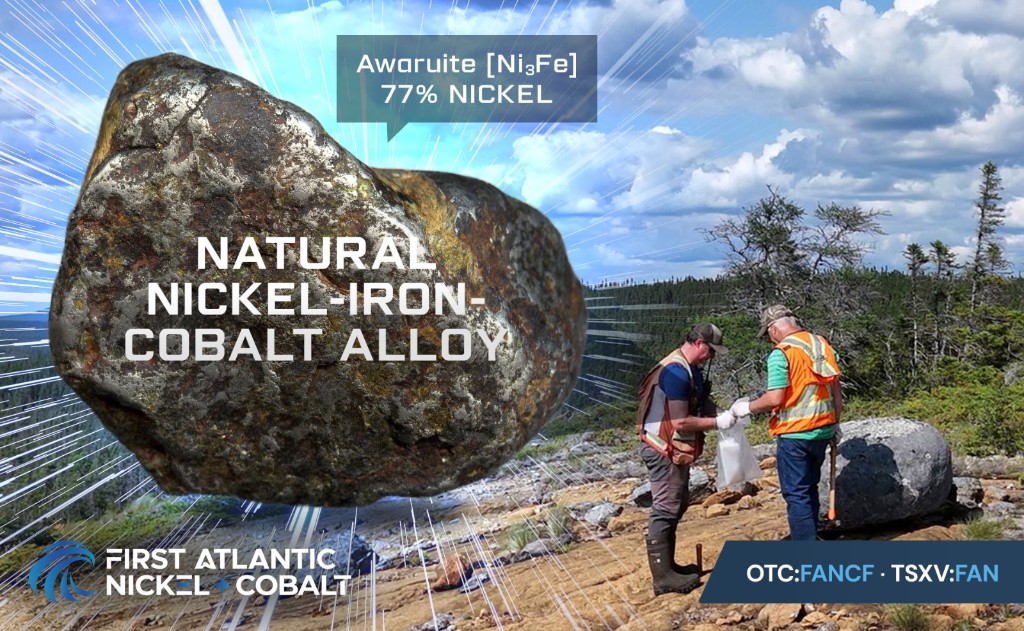
Awaruite (Ni3Fe) offers a pathway to fully vertical critical mineral supply chains inside the G7. Because this sulphur-free, naturally magnetic alloy already exists in metallic form, magnetic separation and flotation can upgrade it directly into a high-grade concentrate of approximately 60% nickel, without the smelting, roasting or high-pressure acid leaching that conventional processing requires, and without the associated electricity demand, emissions and acid-mine-drainage risk. Awaruite concentrate can move directly into downstream battery refining, stainless steel, specialty alloys, aerospace and defence manufacturing. The Company believes this pathway is directly relevant to the processing capacity the G7 is mobilizing to build outside any single dominant supplier.
The U.S. Geological Survey identified this advantage in its 2012 Mineral Commodity Summaries: "Awaruite, a natural iron-nickel alloy, is much easier to concentrate than pentlandite, the principal sulfide of nickel." Today, Chinese firms control roughly 75% of Indonesia's nickel refining capacity, while Indonesia represents a growing share of the world's processed nickel and cobalt supply. According to the U.S. Geological Survey's 2026 Mineral Commodity Summaries for nickel, Indonesia alone accounted for approximately two-thirds of global nickel mine production in 2025, producing 2.6 million of the world's 3.9 million tonnes. Awaruite's simple magnetic-separation and flotation processing can produce a high-grade concentrate at the mine site for direct downstream use in stainless steel, EV battery refining, specialty alloys and other applications, offering a solution to constrained midstream smelting capacity in G7 countries.
On May 21, 2026, the Company announced electron microprobe analysis by SGS Canada Inc. confirming that awaruite at the Pipestone XL Project's RPM Zone averages 77.62% nickel and 1.69% cobalt.
On June 15, 2026, the Company announced a second large-scale awaruite discovery at the Alloy Max Zone, where discovery hole XL-26-15 intersected visible awaruite over its entire 414-metre length and ended in open mineralization.
KEY POINTS
For investor inquiries or questions, please call Rob Guzman, Investor Relations, at +1-844-592-6337 or email rob@fanickel.com.
THE G7 SELECTED NICKEL AS ONE OF ONLY TWO PILOT CRITICAL MINERALS
Under the heading "Transparency and traceability," the G7 leaders state:
"Acknowledging ongoing work by the Organisation for Economic Cooperation and Development (OECD) and International Energy Agency (IEA), we are committed to working towards establishing harmonized, interoperable mechanisms aligned with our interests that ensure traceability and transparency regarding the origin of critical minerals. This would start with two pilot critical minerals – lithium and nickel – and aim to avoid undermining competitiveness or imposing excessive cost burdens. We will seek to extend the pilot to five new critical minerals each year with particular attention given to rare earths."
Nickel and lithium were selected as the two pilot critical minerals to launch the G7's new traceability framework. The Company believes this selection underscores the strategic priority allied governments place on verifying the origin of nickel from trusted jurisdictions, including Canada.
THE G7 COMMITS TO EQUITY INVESTMENT, GUARANTEES AND OFFTAKE
Under the heading "Financing," the G7 leaders state:
"We recognize that the development of industrial capacity, including processing and recycling, necessary for diversification, requires the mobilization of public and private capital, including equity investments, guarantees and offtakes. We recognize the increasing need for stable investment frameworks and for market transparency and valuation for the security of supply. This could incentivize financing of the critical minerals value chains to bridge the investment gap before 2030."
The declaration tasks G7 development finance institutions and export credit agencies with coordinating on critical minerals with the private sector. Canada and the United States are both G7 members and were among founding members of the Minerals Security Partnership. The Company believes this reflects an emerging allied financing architecture for critical minerals projects in in trusted jurisdictions, including nickel and cobalt projects.
THE G7 STANDS AGAINST THE WEAPONIZATION OF MINERAL DEPENDENCE
In its opening, the G7 leaders state:
"We express our grave concerns regarding the use of non-market policies and practices and economic coercion, including arbitrary export restrictions and retaliatory measures on critical minerals and their related dual-use items, all of which undermine economic security and resilience. We will work together with partners to reduce critical dependencies and ensure that attempts or threats to weaponize economic dependencies fail."
The reference to "dual-use items" is consistent with nickel's strategic importance to both energy supply chains and the defence industrial base. Pipestone XL is positioned to supply nickel and cobalt to downstream industries spanning batteries, stainless steel, specialty alloys, aerospace and defence.
NEW G7 CRITICAL MINERALS RESILIENCE AND PRODUCTION ALLIANCE
Under the heading "Critical Minerals Resilience and Production Alliance," the G7 leaders state:
"To achieve these objectives and ensure long-term coordination of our efforts, we establish a non-binding G7 Critical Minerals Resilience and Production Alliance, whose terms are annexed to this declaration. This initiative builds on the existing Critical Minerals Production Alliance and will be open to like-minded partners subject to the approval of participating countries."
The predecessor body was established under the Canada's G7 presidency in 2025. Australia, a G7 partner country, has also expressed support for the declaration. The Company believes the new Alliance may provide a durable, multi-year platform for longer-term coordination among allied countries on critical minerals supply chains, including nickel and cobalt projects in trusted jurisdictions.
NICKEL AND COBALT: CANADA'S PRIORITY MINERALS, NOW AT THE FRONT OF THE G7 AGENDA
Of the 34 minerals on Canada's Critical Minerals List, the federal government has prioritized six: lithium, graphite, nickel, cobalt, copper and rare earth elements. Both nickel and cobalt are included in that priority group. In the G7 declaration, nickel is now one of only two minerals, alongside lithium, chosen to pilot the allied traceability framework.
The alignment is direct. Nickel is one of Canada's six priority critical minerals and is now at the front of the G7's traceability effort. First Atlantic's strategy is built around these same priorities: trusted-source supply, midstream processing, and allied coordination on financing and offtake.
First Atlantic believes the policy direction reflected in the G7 declaration is consistent with the Company's broader strategy to advance a North American nickel-cobalt project capable of supporting downstream industries in the United States and Canada, including battery refining, stainless steel, specialty alloys, defence manufacturing and advanced industrial applications.
AWARUITE: A SMELTER-FREE NICKEL-COBALT ALLOY (Ni₃Fe)
Awaruite is a naturally occurring, sulfur-free nickel-iron-cobalt alloy of approximately 77% nickel. Because it already exists in metallic form, it can be processed into a high-grade concentrate of approximately 60% nickel by magnetic separation and flotation (without smelting, roasting or high-pressure acid leaching) and sent directly to downstream battery-chemical refining or the manufacture of specialty alloys and stainless steel.
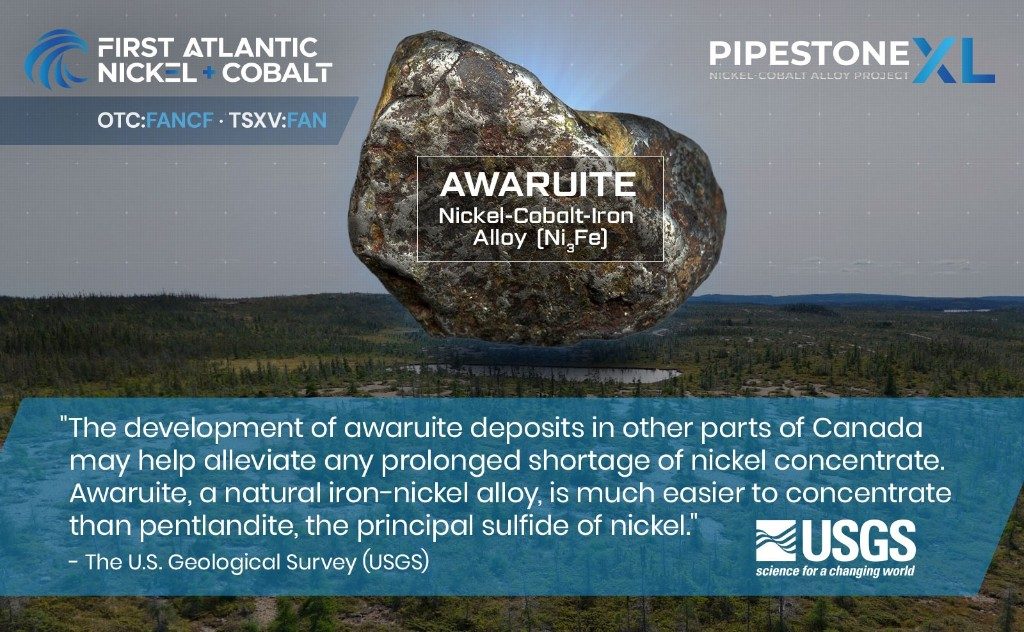
Figure 1: USGS quote on awaruite nickel-iron-cobalt alloy.
As stated in the August 2025 report From Rocks to Power: Strategies to Unlock Canada's Critical Minerals for Global Leadership in Energy Storage, EVs, & Beyond from the Battery Metals Association of Canada:
"Awaruite is not a sulfide nor an oxide nickel ore but a high-content native nickel-iron ore. Simple beneficiation processes after mining could provide 60% Ni concentrate, ready for leaching for battery cathode purposes and would yield MHP as a by-product. This process would bypass pyrometallurgy or early hydrometallurgy stages and be among the lowest carbon-intensive nickel production sites in the global nickel market."
The U.S. Geological Survey highlighted awaruite's potential in its Mineral Commodity Summaries 2012, stating:
"The development of awaruite deposits in other parts of Canada may help alleviate any prolonged shortage of nickel concentrate. Awaruite, a natural iron-nickel alloy, is much easier to concentrate than pentlandite, the principal sulfide of nickel."
The absence of sulfur reduces the risk of acid mine drainage and certain permitting challenges commonly associated with sulfide mineralization, positioning awaruite to supply North American industries including stainless steel, electric vehicles, aerospace, and defence.
INVESTOR INFORMATION
The Company's common shares trade on the TSX Venture Exchange under the symbol "FAN", the American OTCQB Exchange under the symbol "FANCF" and on several German exchanges, including Frankfurt and Tradegate, under the symbol "P21".
Investors can get updates about First Atlantic by signing up to receive news via email and SMS text at www.fanickel.com.
For further information, please contact:
Rob Guzman
Investor Relations
1 (844) 592-6337
rob@fanickel.com
Qualified Person
Adrian Smith, P.Geo., a director and the Chief Executive Officer of the Company is a qualified person as defined by NI 43-101. The qualified person is a member in good standing of the Professional Engineers and Geoscientists Newfoundland and Labrador (PEGNL) and is a registered professional geoscientist (P.Geo.). Mr. Smith has reviewed and approved the technical information disclosed herein.
About First Atlantic Nickel & Cobalt Corp.
First Atlantic Nickel & Cobalt Corp. (TSXV: FAN) (OTCQB: FANCF) (FSE: P21) is a critical mineral exploration company in Newfoundland & Labrador developing the Pipestone XL Nickel-Cobalt Alloy Project. The project spans the entire 30-kilometer Pipestone Ophiolite Complex, where multiple zones, including RPM, Alloy Max, Super Gulp, Atlantic Lake, and Chrome Pond, contain awaruite (Ni₃Fe), a naturally occurring magnetic nickel-iron-cobalt alloy of approximately ~77% nickel with no sulfur and no sulfides, along with secondary chromium mineralization. Awaruite's sulfur-free composition removes acid mine drainage (AMD) risks, while its unique magnetic properties enable processing through magnetic separation, eliminating the electricity requirements, emissions, and environmental impacts of conventional smelting, roasting, or high-pressure acid leaching while reducing dependence on overseas nickel processing infrastructure.
The U.S. Geological Survey recognized awaruite's strategic importance in its 2012 Annual Report on Nickel, noting that these deposits may help alleviate prolonged nickel concentrate shortages since the natural alloy is much easier to concentrate than typical nickel sulfides. The Pipestone XL Nickel-Cobalt Alloy Project is located near existing infrastructure with year-round road access and proximity to hydroelectric power. These features provide favorable logistics for exploration and future development, strengthening First Atlantic's role to establish a secure and reliable source of North American nickel production for the stainless steel, electric vehicle, aerospace, and defense industries. This mission gained importance when the U.S. added nickel to its critical minerals list in 2022, recognizing it as a non-fuel mineral essential to economic and national security with a supply chain vulnerable to disruption.
Neither the TSX Venture Exchange nor its Regulation Services Provider (as that term is defined in policies of the TSX Venture Exchange) accepts responsibility for the adequacy or accuracy of this release.
Forward-Looking Statements
This news release contains certain forward-looking information and forward-looking statements within the meaning of applicable securities laws. Forward-looking statements are frequently identified by words such as "expects", "intends", "plans", "anticipates", "believes", "may", "will", "would", "could", "potential", "proposed", "target", "prospective", "indicates", "designed to", "expected to" and similar expressions, or statements that events, conditions or results "will", "may", "could", "would" or "should" occur or be achieved.
Forward-looking information in this news release includes, but is not limited to, statements regarding: the Company's plans, objectives and strategy for the Pipestone XL Nickel-Cobalt Alloy Project; the potential for the Project to become a North American or allied source of nickel-cobalt awaruite; the potential for awaruite to be processed by magnetic separation and flotation into a high-grade nickel concentrate; the potential for such concentrate to be used in downstream battery refining, stainless steel, specialty alloys, aerospace, defence and other industrial applications; the potential relevance of the Project or awaruite processing to G7 critical minerals policy objectives, traceability frameworks, supply chain diversification, midstream processing capacity, financing, offtake or strategic mineral supply; the potential benefits of awaruite mineralization, including with respect to processing, emissions, electricity demand, acid mine drainage, permitting, smelting, roasting or high-pressure acid leaching; the potential for the Company's projects to benefit from government policies, alliances, financing tools, export credit agencies, development finance institutions, offtake arrangements or other critical minerals initiatives; the potential scale, significance, continuity or economic relevance of mineralization at the RPM Zone, Alloy Max Zone or elsewhere on the Project; and the Company's expectations regarding future exploration, development, metallurgical testing, processing, supply chain positioning and strategic opportunities.
Forward-looking information is based on a number of assumptions that the Company considers reasonable as of the date of this news release, including assumptions regarding: the continued strategic importance of nickel and cobalt to Canada, the United States and other G7 jurisdictions; the continued relevance of critical minerals policy initiatives and allied supply chain diversification efforts; the accuracy of third-party information and policy statements referenced in this news release; the Company's ability to continue exploration and technical work at the Project; the continued availability of financing, personnel, contractors, equipment and regulatory approvals on acceptable terms; the validity of historical, technical, geological, metallurgical and analytical information available to the Company; the potential amenability of awaruite mineralization to magnetic separation and flotation; and general business, economic, market, political and regulatory conditions.
Forward-looking information is subject to known and unknown risks, uncertainties and other factors that may cause actual results, events or developments to differ materially from those expressed or implied by such forward-looking information. These risks and uncertainties include, among others: risks related to mineral exploration and development; the early-stage nature of the Project; uncertainty as to the continuity, grade, scale, metallurgical characteristics or economic viability of mineralization; risks that future exploration, drilling, sampling, assaying, metallurgical testing or technical studies may not confirm the Company's expectations; risks that processing methods described in this news release may not prove technically feasible, economically viable or commercially scalable; risks relating to commodity prices, capital markets, availability of financing and changes in investor or government support for critical minerals projects; risks that G7, Canadian, U.S. or other policy initiatives, frameworks, alliances, financing tools, offtake arrangements or traceability mechanisms may not be implemented, may be modified, may not provide any benefit to the Company or may not be available to the Project; regulatory, permitting, environmental, title, Indigenous consultation, community relations and land access risks; operational risks; reliance on third-party information; geopolitical and supply chain risks; and the other risks described in the Company's public disclosure documents available under the Company's profile on SEDAR+.
Although the Company believes that the assumptions and expectations reflected in the forward-looking information are reasonable, there can be no assurance that such assumptions or expectations will prove to be correct. Forward-looking information speaks only as of the date of this news release. The Company does not undertake to update any forward-looking information, except as required by applicable securities laws.
The G7 Leaders' Declaration is a statement of policy and intent among G7 governments and does not create any direct or indirect benefit, entitlement, funding, financing, offtake, permitting advantage or commercial opportunity for the Company or its projects. There can be no assurance that any framework, alliance, financing tool, traceability mechanism, offtake initiative or other measure described in or associated with the declaration will be implemented, or that the Company, the Pipestone XL Project or any of the Company's activities will qualify for, receive or benefit from any such initiative.
Our White Paper on Onshoring the North American Nickel-Cobalt Supply Chain
Now available — enter your email and we’ll send it to you instantly.

